Two Barrels, One Reputation: The ADEN Cannon in RAF Jaguar Service
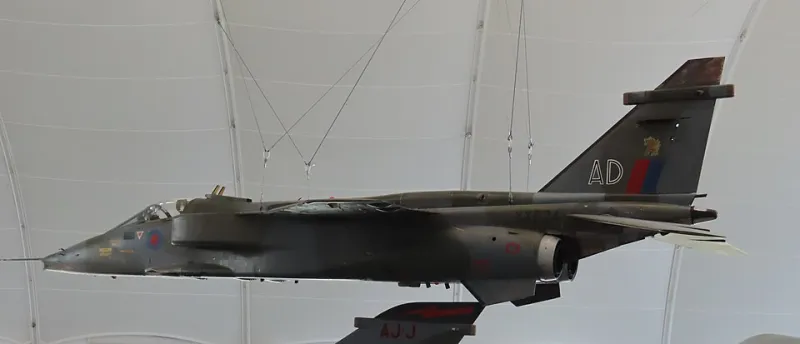
Photo: [[User:Ad Meskens|Ad Meskens You are free to use this picture for any purpose as long as you credit its author, Ad Meskens. Example: © Ad Meskens / Wikimedia Commons If you use this work outside of the Wikimedia projects, a message or a copy is
A gun fit that was never an afterthought
The RAF Jaguar is usually introduced through its stores: the reconnaissance pod, the cluster bombs, the drop tanks. Yet the two 30 mm ADEN cannon mounted low in the forward fuselage were part of the aircraft's definition from the outset. They gave the Jaguar an organic strafing capability that did not depend on a pylon, a programme or a clearance round, and they imposed their own engineering compromises on the airframe. To treat the gun as a secondary fit is to misread both the aircraft and the way its crews thought about it.
Installation, feed and the ammunition problem
The RAF installation comprised two ADEN cannon, one on each side of the lower forward fuselage, fed from ammunition boxes within the same bay. The weapon was a revolver-type design with a high rate of fire, and the Jaguar's installation reflected the usual British preference for a linkless feed: rounds were drawn from the boxes through chutes rather than a disintegrating-link belt, reducing the clutter and the debris that a belt system leaves behind. The published figure of roughly 150 rounds per gun looks generous until the rate of fire is considered. A two-second burst could consume a substantial fraction of the magazine, and crews quickly learned that the gun rewarded discipline rather than enthusiasm.
The ammunition itself was the familiar 30 x 113 mm round, a family with a long RAF pedigree. Its projectile mass and muzzle energy gave the ADEN a useful punch against light armour, vehicles and soft-skinned targets, but the cartridge also produced a pronounced muzzle blast and a considerable volume of propellant gas. Those two products of the design are central to understanding why the Jaguar's gun installation was never simply a matter of bolting two cannon into a bay.
Gun gas and the engineering argument
The Jaguar's Adour engines were installed with the airflow and surge margins of a low-level strike aircraft, not those of a dedicated gun platform. Firing the ADEN produced gas in the vicinity of the engine intakes, and the RAF handling notes reflected that reality. Burst lengths were restricted, firing envelopes were qualified, and the aircraft carried arrangements intended to deflect or disperse the gas. Squadron recollections and maintenance lore both refer to the care taken over gun gas, and the subject appears in the technical documentation as a live engineering issue rather than a footnote.
This is the point at which the gun stops being a simple weapon and becomes part of the aircraft's systems story. A pilot could not treat the cannon as a limitless resource: the same burst that put rounds on a target could disturb the engine that was keeping the aircraft in the air. The result was a practical doctrine of short, controlled bursts, and a ground organisation that understood the gun as an aircraft system with airframe and powerplant consequences.
Sighting, harmonisation and the strafing run
The Jaguar's nav/attack system gave the crew a computed sight line in the head-up display, and the air-to-ground gun mode was part of the standard repertoire. In practice, strafing remained a demanding manoeuvre. Crews flew a shallow dive, typically in the region of ten to fifteen degrees, and aimed to fire at a range that balanced accuracy against the time available to break away. The gun's high rate of fire meant that a brief squeeze produced a dense pattern, and the sight settings, harmonisation and range estimates all had to agree if the pattern was to land where the crew intended.
Harmonisation was a ground-crew task as much as a cockpit one. The guns had to be aligned to the sight, and the process had to be repeated after removal and refit. Bore sighting, adjustment and the verification of the sight line were routine but unforgiving: a small error at the gun translated into a large dispersion at range. The Jaguar's gun was therefore not simply fired; it was maintained into accuracy.
The gun bay and the ground crew
The gun bay itself was cramped and hot, and the cannon were not the most accessible items on the aircraft. Removal and refit were deliberate tasks, carried out through access panels that demanded care and a certain amount of bodily contortion. The guns had to be cleaned, inspected and returned to service, and the residue of firing had to be dealt with before the bay could be considered serviceable. Muzzle blast left its mark on paint and panel edges, a small but persistent reminder that the installation was a working one.
For the flight line, the gun introduced its own rhythm. Rearming was not merely a matter of lifting boxes into a bay; the feed path had to be checked, the gun charged and the system tested. The maintenance schedules and the squadron lore agree on one point: a gun that had been fired was a gun that required attention. That attention was part of the daily life of a Jaguar squadron, and it is poorly represented by the usual emphasis on pylons and payloads.
Operational record and reputation
The Jaguar's cannon was used in anger. In April 1994, RAF Jaguars operating over Bosnia employed cannon fire against a Serb armoured vehicle, an episode often cited in accounts of the type's Balkan service. It was the kind of target for which the ADEN had been intended: a point target, a fleeting opportunity, and a weapon that could be brought to bear without a large stores programme. The gun also had a place in the low-level training routine over Germany, where crews practised strafing patterns as part of the wider attack repertoire.
None of this made the Jaguar a dedicated gun platform in the manner of the Harrier, and it is important not to overstate the case. The aircraft's reputation rested on its ability to deliver a varied load at low level and over distance. But the ADEN gave that reputation a hard edge. It meant the Jaguar could engage a target when bombs were inappropriate, and it gave crews a direct, visual connection between the aircraft and the ground that a ballistic bomb fall could not provide.
Conclusion
The two barrels in the Jaguar's belly were not an afterthought. They were an integral part of the aircraft's identity, with their own installation, feed, gas and maintenance problems. The gun shaped tactics, imposed engineering limits and gave the Jaguar a close-support capability that its crews understood and used. To read the RAF Jaguar only through its bomb load is to miss the argument that the gun bay makes: that this was an aircraft designed to fight at low level, with everything that fighting at low level implies.