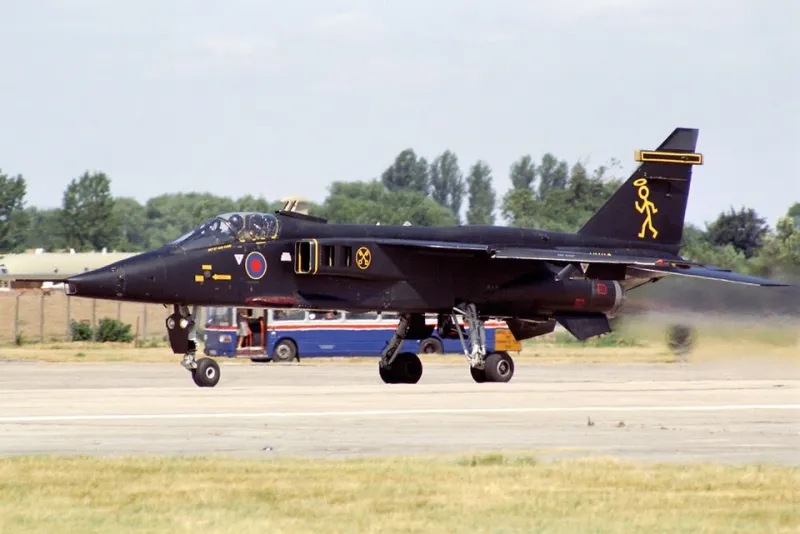
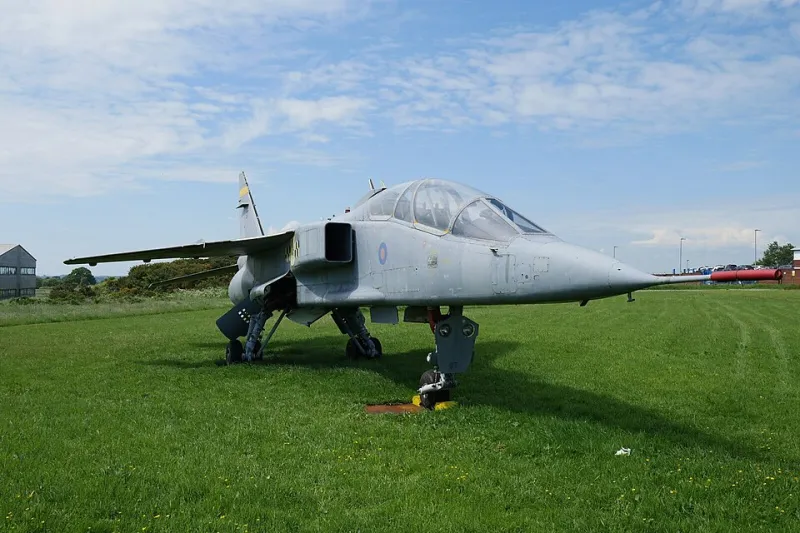
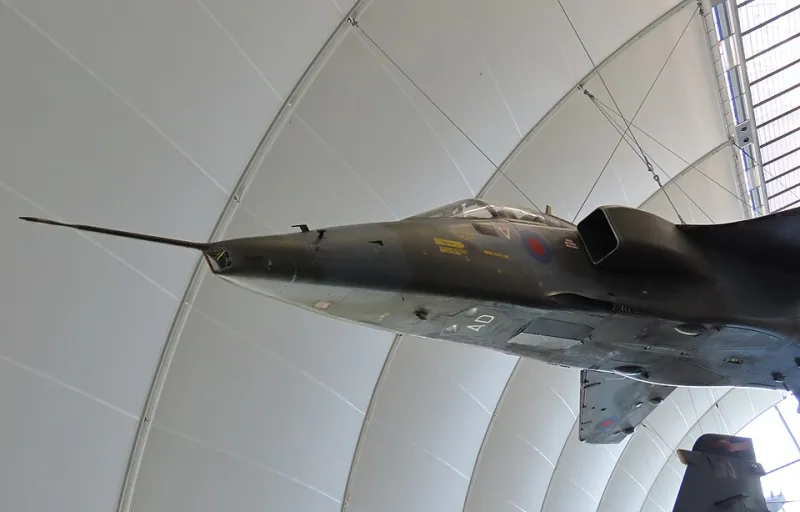
Ground Truth: Synthetic Training and the Making of a RAF Jaguar Crew
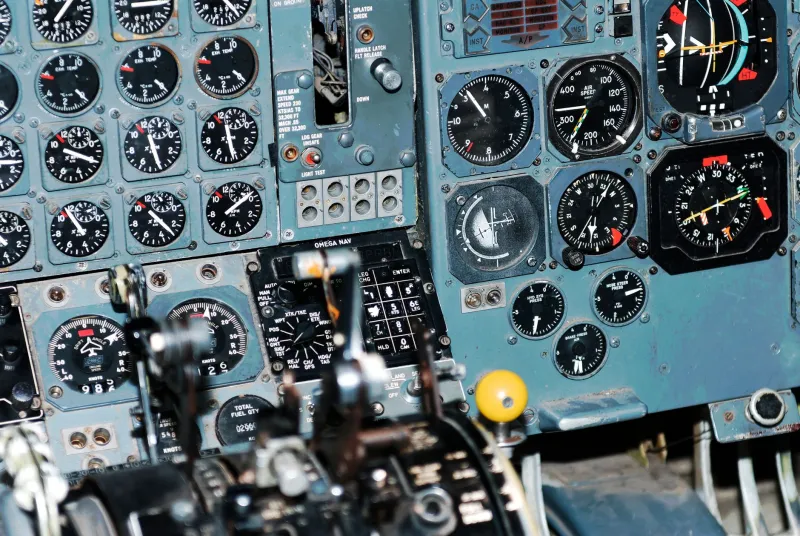
The RAF Jaguar was never short of demands on its crews. Low-level strike flying required precise navigation, disciplined timing, rapid weapon selection and an ability to manage a dense cockpit while the ground rushed past at close quarters. Reconnaissance work added its own pressures: the need to hold a heading, maintain height and capture the right sensor coverage without losing sight of the aircraft's position. Yet much of the preparation for those sorties took place before the engine was started, in rooms where the aircraft was represented by a cockpit mock-up, a part-task console or a simulator with a visual display of limited fidelity. Understanding those devices matters, because they shaped how crews thought about the aircraft long before they flew it.
The ground-school problem
Jaguar training from the 1970s onward had to produce crew members for a demanding, single-seat strike aircraft and for the two-seat training variants that supported it. The syllabus at the operational conversion unit could not rely on airborne hours alone. Fuel, airframe fatigue, weather, range availability and the cost of flying all placed limits on how much could be taught in the air. Ground-based training offered a controlled environment in which procedures could be introduced, repeated and corrected without the pressures of a live sortie. It also allowed instructors to stop the exercise, discuss a mistake and run the sequence again.
The earliest devices were modest by later standards. Cockpit mock-ups and procedures trainers gave students their first structured contact with switch positions, selector settings and emergency drills. These were not flight simulators in the modern sense. They were teaching machines designed to build familiarity and to catch errors before they became habits. For a aircraft with a busy cockpit and a complex nav-attack system, that early repetition was valuable. It allowed the student to learn where things were and in what order they should be moved.
Cockpit drills and the procedures trainer
A significant part of Jaguar ground training concerned normal and emergency procedures. The procedures trainer could replicate the layout and responses of the aircraft's systems without the need for a full visual scene. Students practised engine handling, hydraulic and electrical failures, fuel management and the sequence of actions required for a range of abnormal conditions. The instructor could introduce faults and observe whether the student followed the correct drill, rather than simply recalling the right answer in a classroom.
This was particularly important for a strike aircraft expected to operate at low level, where a systems failure might leave little time for reflection. The procedures trainer did not reproduce the noise, vibration or urgency of the real aircraft, but it did enforce order. It taught crews to work through checks methodically and to understand the consequences of each action. Veteran accounts often describe these sessions as repetitive and unglamorous, but they also acknowledge that the repetition paid off when a real emergency demanded an immediate response.
Cockpit mock-ups also supported egress and safety training. Crews needed to be familiar with the ejection seat, canopy operation and the sequence for abandoning the aircraft. These drills were physical as well as procedural, and the mock-up provided a safe way to rehearse them. The training was not intended to simulate the full violence of an ejection, but to ensure that the actions were second nature.
Part-task devices and the weapon-aiming chain
The Jaguar's operational role placed heavy emphasis on weapon delivery and, in reconnaissance variants, on sensor management. Part-task trainers allowed crews to concentrate on specific elements of that chain. A weapon-aiming trainer, for example, could present a simplified attack geometry and allow the student to practise the sequence from target acquisition to release. The device did not need to reproduce the entire aircraft to be useful. It needed to represent the relevant inputs, outputs and timings with enough accuracy to teach the correct technique.
Similarly, navigation and sensor trainers could focus on the skills that were difficult to practise intensively in the air. Low-level navigation demanded constant map reading, timing and heading control. A ground trainer could present a route, introduce changes and require the student to maintain awareness without the distraction of flying the aircraft. That separation of tasks was valuable in the early stages of training, when a student needed to master one skill before combining it with another.
The limits of these devices were real. A part-task trainer could not replicate the full workload of the cockpit, the effect of turbulence or the visual cues of a real low-level run. It could, however, reduce the number of airborne hours needed to reach a basic standard. That mattered in a force where flying hours were a finite resource.
The full mission simulator and its limits
By the later decades of the Jaguar's RAF service, full mission simulators had become more capable. They offered a enclosed cockpit, a visual scene and the ability to run representative sorties. Crews could practise instrument approaches, emergency handling, navigation and some weapon-delivery sequences without leaving the ground. The simulator could be frozen, reset or repeated, and instructors could introduce failures that would be unsafe or impractical to rehearse in the air.
Yet the fidelity of these devices should not be overstated. Visual systems of the period were limited in resolution, field of view and terrain detail. The synthetic scene could not fully reproduce the cues that mattered at low level: the texture of the ground, the sense of speed, the peripheral awareness of obstacles and the psychological pressure of flying close to the surface. Motion systems, where fitted, were helpful but not a substitute for the real accelerations and vibrations of the aircraft. The simulator could teach procedure and instrument interpretation, but it could not teach the physical sensation of low-level flight.
There were other gaps. Synthetic training could not fully represent the electronic threat environment, the behaviour of real sensors or the coordination of a formation of aircraft. Nor could it reproduce the wear and tear of a long sortie, the fatigue that accumulates in the cockpit or the unexpected events that arise when weather, traffic and equipment interact. These limitations meant that simulator time was seen as complementary to flying, not a replacement for it.
What synthetic time could not teach
The most honest assessment of Jaguar ground training is that it was strongest where the task could be broken down and made predictable. Switch drills, emergency procedures, instrument approaches and weapon-aiming sequences could all be taught and practised on the ground. These were the foundations on which airborne training built. The simulator and part-task devices gave students the confidence to handle the aircraft's systems so that, in the air, they could concentrate on the tactical problem.
What synthetic training could not do was replicate the full sensory and psychological reality of a low-level sortie. The ground rush, the noise, the vibration, the tension of a real threat environment and the responsibility of managing a live aircraft could only be experienced in flight. The best ground training acknowledged this. It did not try to pretend that the simulator was the aircraft; it used the device to prepare the crew for the parts of the sortie that could be rehearsed, leaving the rest to be learned in the air.
Legacy
Surviving training equipment from the Jaguar era offers a useful reminder of how much preparation took place before a sortie. Cockpit sections, procedures trainers and simulator hardware preserved in museums and private collections show the physicality of that training. They also show its limitations: the simplified visuals, the mechanical switches and the absence of the full aircraft context. For historians, these devices are evidence of a training philosophy that valued repetition, procedural discipline and the careful sequencing of skills.
The RAF Jaguar force depended on that philosophy. Synthetic strike training was never a substitute for flying, but it was an essential part of the process that turned a student into a crew member. It provided the ground truth against which airborne training could be measured, and it left a legacy that later fast-jet training would build upon.