The Instructor's Cockpit: Britain's Two-Seat Jaguars and the Crews They Forged
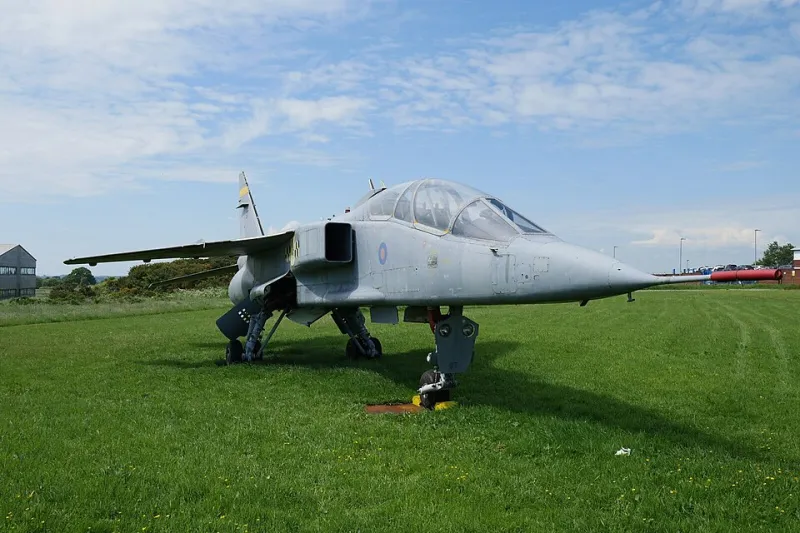
Photo: James T M Towill , CC BY-SA 2.0, via Wikimedia Commons
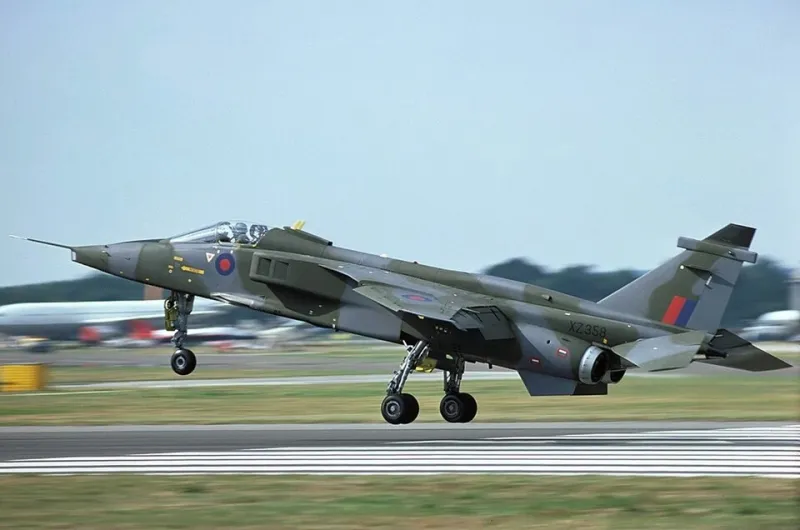
In the popular memory of the SEPECAT Jaguar, the single-seat strike machine dominates. The two-seaters are often remembered as trainers, useful but secondary. That view undersells them. The RAF's twin-stick Jaguars were a distinct sub-fleet, with their own design compromises, their own careers and a quiet influence on the frontline force that outlasted many of the squadrons they served.
A longer fuselage and a different nose
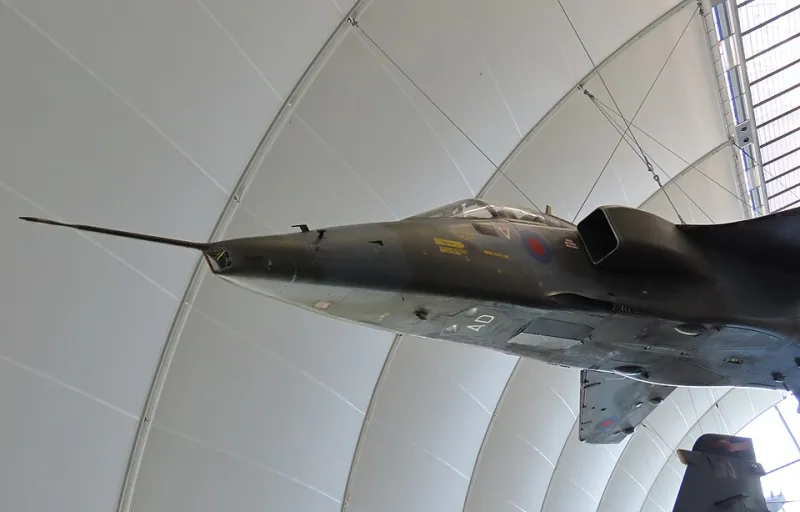
The most visible difference was the tandem cockpit. The rear seat sat under a taller canopy, stepped up to give the instructor a view over the pupil's head. To make room, the forward fuselage was stretched. The change was not a simple insertion of a second seat: the nose lost the laser rangefinder and marked-target seeker fitted to the strike Jaguar, and the forward bay housed different avionics and environmental equipment. Internal fuel and systems were rebalanced around the training task. The result was an aircraft that looked like a Jaguar, flew like a Jaguar, but was not interchangeable with the single-seater.
The T.2 and the conversion task
The T.2 was the RAF's original two-seat Jaguar, entering service with the force in the early 1970s. Its work was concentrated in the conversion role. 226 OCU, first at Lossiemouth and later at Coltishall, used the type to turn experienced pilots into Jaguar crews, teaching the low-level strike profile, the nav-attack system and the discipline of operating a demanding aircraft at low altitude. The two-seater was not a gentle introduction. It had the same thrust, the same handling characteristics and much of the same equipment as the frontline machine, which was the point. An instructor in the rear seat could watch a pupil make mistakes in an aircraft that behaved like the real thing.
T.4: keeping pace with the frontline
As the single-seat force was upgraded, the two-seaters followed. The T.4 designation covered T.2 airframes brought closer to the later GR.1A and GR.1B standard, with revised navigation and cockpit equipment that bore more resemblance to the frontline aircraft. The T.4 was still a trainer, not a combat variant, but it allowed crews to practise against a cockpit layout that was closer to the aircraft they would fly operationally. This mattered. A trainer that drifts too far from the frontline type creates its own training burden; the T.4 programme was an attempt to keep the two-seat fleet relevant as the Jaguar's systems evolved.
Squadron hacks and odd jobs
Beyond the OCU, two-seaters appeared on squadron strength as hacks. They were used for currency and instrument practice, for liaison flights, for test sorties after servicing and for the general run of tasks that keep a squadron functioning. They could carry external stores and practise attacks, so they were not confined to gentle circuits. Some were used for display and photography, their second cockpit useful for observers. The two-seat Jaguar was never the main event, but it was a force multiplier in a quiet way: it kept instructors current, gave squadron pilots a convenient way to maintain skills and allowed the frontline force to concentrate its single-seaters on operational tasks.
What survives in 2026
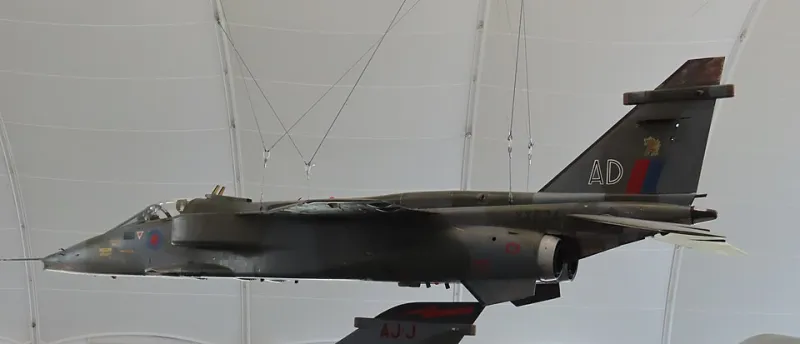
The RAF's Jaguars left service in 2007, and the two-seaters were always a minority. As of 2026, survivors are scarce. The RAF Museum's collection includes a two-seat Jaguar; the Yorkshire Air Museum and the Boscombe Down Aviation Collection hold further examples; a small number remain in private storage. Condition varies, and complete airframes are rarer than the total of preserved Jaguars might suggest, because many were scrapped during disposal. For the enthusiast, the two-seater is a reminder that the Jaguar force was not built on single-seaters alone. It depended on a training chain, and the twin-stick Jaguars were the visible top of that chain.
The two-seat Jaguar was not a glamorous aircraft. It did not carry the squadron markings of a strike unit in its prime, and it did not fire weapons in anger. Its contribution was measured in crews passed, currencies maintained and standards upheld. In a force that asked a great deal of its pilots, that was no small thing.