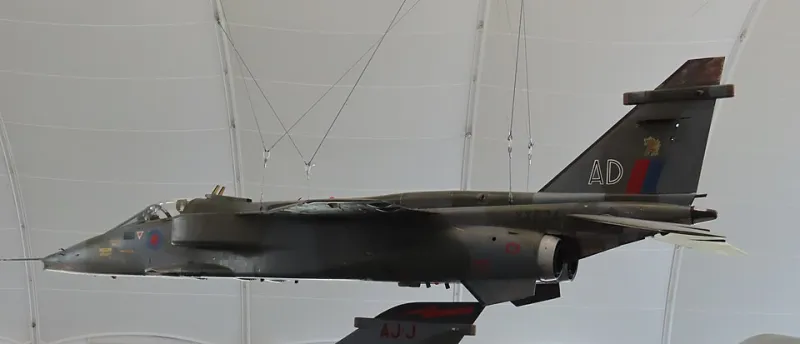
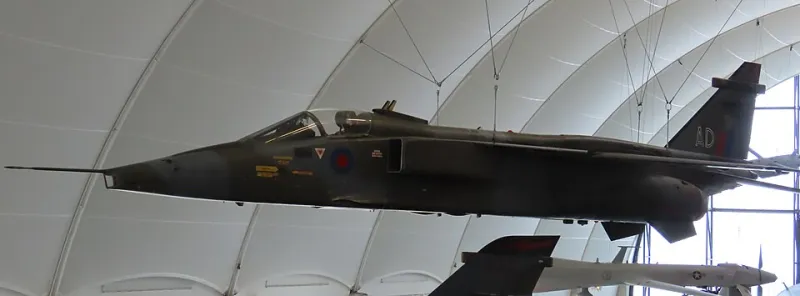
Systems First: Reappraising the Jaguar Beyond Its Bomb-Truck Reputation
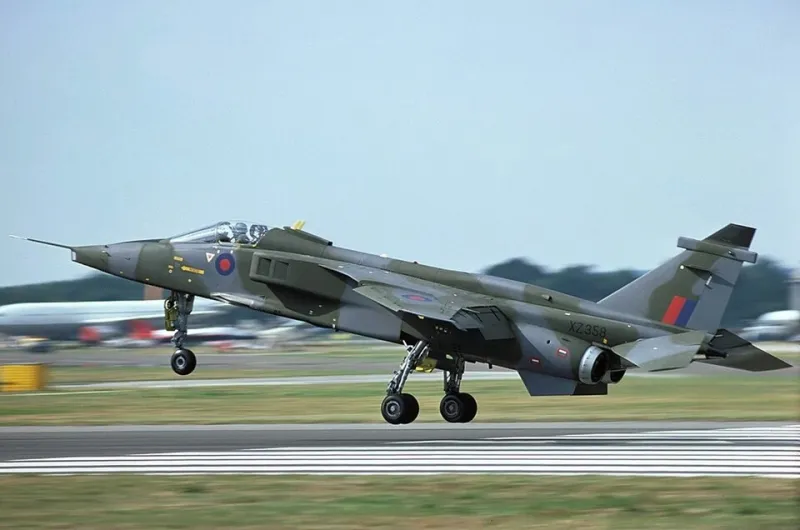
Photo: Mike Freer - Touchdown-aviation, GFDL 1.2, via Wikimedia Commons
Ask a casual enthusiast about the SEPECAT Jaguar and the reply often settles on a familiar phrase: bomb truck. It is not an unfair description. The Jaguar was rugged, lively at low level and capable of carrying a useful load of unguided bombs and rockets. But the phrase has become a substitute for analysis. It hides the very features that make the Jaguar interesting as a piece of aviation technology and that explain why it remained useful for so long.
The Jaguar was not merely a fast jet with pylons. Its significance lies in the way navigation, aiming, sensor information and stores management were brought together in a single operational system. That system was not perfect, and it was not the most advanced in every respect. But it was coherent, and coherence is what turns an aircraft into a weapon system.
The Nav-Attack Loop
The Jaguar GR1 was built around a navigation and weapon-aiming system that brought together an inertial navigation platform, a digital weapon-aiming computer, a head-up display and a nose-mounted laser rangefinder and marked-target seeker. The precise equipment fit changed across marks and upgrades, but the principle remained consistent: the aircraft helped the crew to know where it was, to acquire a target and to compute an aiming solution.
That may sound modest by the standards of a modern multi-role fighter, but it was significant for a light strike aircraft of the Jaguar's generation. The crew was not simply looking through a gunsight and guessing. The system could support low-level navigation, target ranging and weapon delivery in a way that reduced workload and improved consistency. The laser rangefinder and marked-target seeker were particularly important for visual attacks, giving the aircraft a means of measuring range and maintaining a designation without relying entirely on the pilot's eye.
The Jaguar was never a radar-equipped all-weather attacker in the manner of the Tornado. It lacked the terrain-following radar and long-range sensor suite that made the Tornado a different kind of machine. But it would be a mistake to treat that absence as evidence that the Jaguar was technologically simple. It was a visual-conditions strike aircraft with an integrated nav-attack loop, and that loop was the heart of its operational value.
Engines and Installation
The Jaguar's propulsion system is another area where the bomb-truck label obscures good design. The aircraft was powered by two Rolls-Royce Turbomeca Adour afterburning turbofans, mounted side by side in the rear fuselage. The installation gave the Jaguar redundancy, useful thrust for a strike load and a robust operational character. The Adour was not a miracle of fuel efficiency, and the Jaguar's range was always a consideration, but the engine installation suited the aircraft's role.
Side-mounted engines made access and maintenance more straightforward than a buried single-engine layout might have done. The Jaguar was designed with operational practicality in mind, and the engine installation reflected that. It also contributed to the aircraft's survivability in a broad sense: two engines gave a margin that a single-engine light strike aircraft could not offer, particularly over hostile territory.
The penalty was fuel consumption. The Jaguar was thirsty at low level, especially with a full stores load, and external tanks became a routine part of operational planning. That is not a trivial point. It shows how the aircraft's systems and propulsion shaped the way it was used. The Jaguar was not a long-range interdiction bomber in the Buccaneer mould. It was a short-range, high-tempo strike aircraft whose performance had to be managed carefully.
Stores, Growth and Maintainability
The Jaguar's stores flexibility is well known, but it deserves to be understood as a systems feature rather than a simple question of how many bombs could be hung under the wings. The aircraft had a practical arrangement of underwing and centreline pylons, and later marks added overwing Sidewinder rails for self-defence. It could carry conventional bombs, rockets, cluster munitions, external tanks, reconnaissance pods and electronic warfare equipment. Later upgrades brought compatibility with precision-guided weapons and targeting pods, including TIALD, and improved cockpit displays, GPS and defensive systems.
That growth was possible because the aircraft had been designed with wiring, computing and stores management in mind. A bomb truck can carry things. A systems aircraft can integrate them. The Jaguar's ability to adapt to new stores and sensors over its service life is evidence that it belonged more to the second category than its reputation suggests.
Maintainability was part of the same story. The Jaguar was not a delicate aircraft. Access panels, modular avionics and a practical engine installation allowed ground crews to work on the aircraft in operational conditions. That mattered in RAF Germany, where readiness was measured in sorties rather than spectacle, and it mattered later in deployed operations. A system that cannot be maintained is not a system at all. The Jaguar's design recognised that.
Where It Stood
Judged against its contemporaries, the Jaguar occupied a distinctive position. It was ahead of the Harrier GR3 in navigation and attack integration, offering a more sophisticated approach to target acquisition and weapon aiming. It was behind the Buccaneer in radar and terrain-following capability, and behind the Tornado in all-weather, long-range strike systems. It was not the most advanced aircraft in the RAF's inventory, but it was a well-integrated one.
That is the key point. The Jaguar's contribution was not that it possessed the most powerful sensor or the longest range. It was that its systems worked together in a way that suited its mission. The aircraft gave crews a manageable workload at low level, a useful range of stores and a robust maintenance baseline. Those qualities are less dramatic than top speed or bomb load, but they are more revealing of engineering intent.
Why Study It
UK enthusiasts should study the Jaguar as a systems aircraft because that is where its real character lies. The bomb-truck image captures the silhouette and the payload, but it misses the navigation and attack loop, the engine installation, the stores growth and the maintenance philosophy. It also misses the operational context. The Jaguar was not designed to be a showpiece. It was designed to be used, and its systems were shaped by that requirement.
The type's later combat deployments, including Operation Granby and subsequent operations in the Balkans, demonstrated that the Jaguar could adapt. Those deployments are often remembered for the aircraft's presence rather than its systems, but the two cannot be separated. The Jaguar went to war as an integrated machine, not as a collection of parts. That is the case for reappraisal. The Jaguar was a bomb truck, but it was a systems jet first, and that is why it deserves close technical attention in 2026 and beyond.