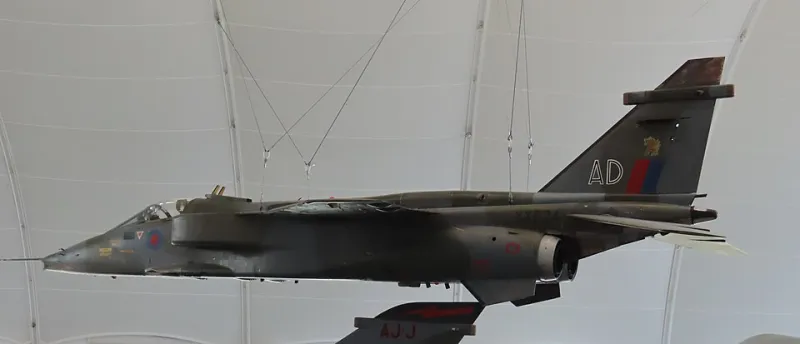
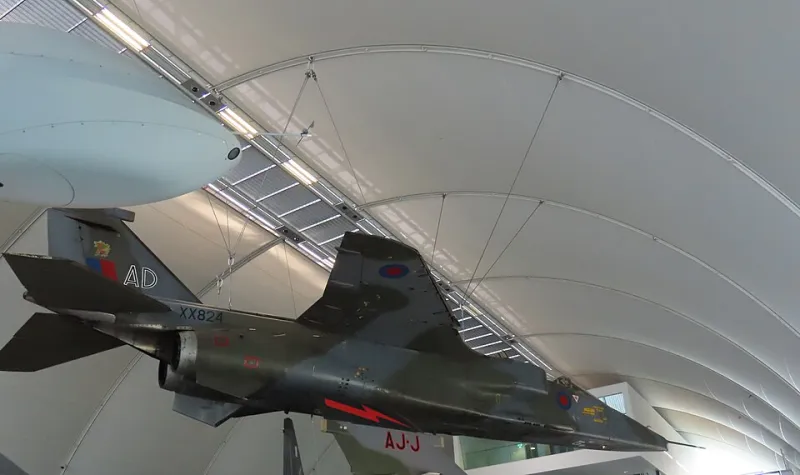
Studies That Never Left the Page: Jaguar Growth, Exports and the Road Not Taken
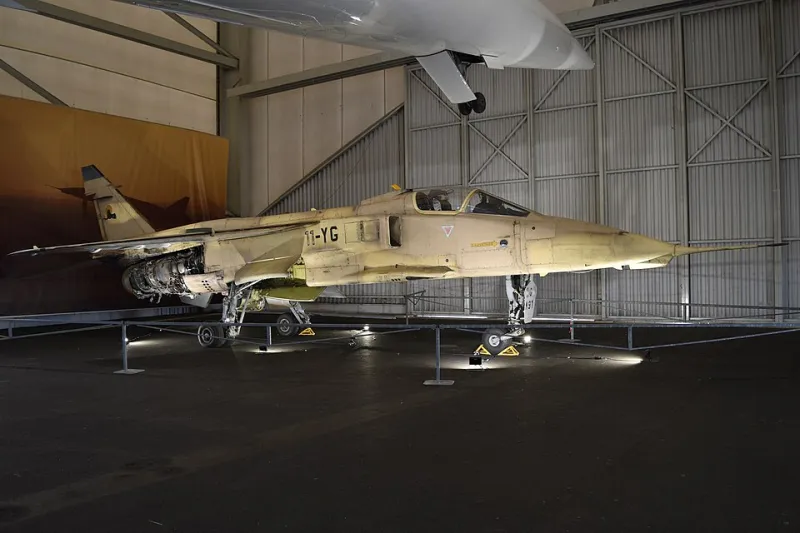
Photo: Alan Wilson from Peterborough, Cambs, UK, CC BY-SA 2.0, via Wikimedia Commons
The SEPECAT Jaguar is usually discussed as a delivered aircraft: a Anglo-French strike machine that entered service, was upgraded, exported and eventually retired from the RAF. But the archive also contains a shadow fleet. These are the Jaguars that were studied, sketched, costed and marketed but never built in the proposed form. In 2026 they remain useful because they show the limits of a successful airframe as much as its strengths.
The upgrade temptation
The RAF's Jaguar fleet did receive real improvements. The GR1A introduced reconnaissance and laser-ranging equipment; the GR3 and GR3A brought revised avionics, cockpit displays and weapon compatibility. These were incremental changes designed to keep a mature aircraft credible in a changing threat environment. The paper studies went further.
Archive material and procurement histories point to repeated interest in larger changes: revised engines, digital mission systems, new cockpit architecture and structural life-extension work. Such studies were logical. A larger engine or a more capable sensor suite could have addressed the Jaguar's known weaknesses in payload-range and survivability. But each proposal had to compete against the cost of the existing fleet, the attractions of Tornado and the emerging Eurofighter programme, and the simple fact that the RAF's Jaguar force was finite.
The result was a familiar pattern. Studies that promised modest through-life savings or clear operational gain progressed. Studies that required a new engine, major structural change or a rewritten support contract stalled. The paper Jaguars were not rejected because they were technically absurd. They were rejected because the procurement system could not justify the bill against a fleet that was already being counted down.
The export brochure
The export story is more varied. The Jaguar International was a genuine export success in several markets, and it gave the type a life beyond the RAF and the Armée de l'Air. But around that success sat proposals for customers and roles that never materialised. Brochures described specialised reconnaissance fits, anti-ship options, revised trainers and avionics packages tailored to particular air forces. Some were serious; others were sales literature doing what sales literature does.
The export market was not a simple test of aircraft quality. It was shaped by price, politics, training packages, offsets and the willingness of supplier nations to release technology. A customer comparing the Jaguar with the F-16, Mirage 2000 or a refurbished Soviet type was not comparing airframes alone. It was comparing support chains, financing and alignment. Many paper Jaguars died in that broader calculation rather than in wind-tunnel testing.
There is also a boundary case worth noting. The navalised Jaguar M was built and flown, so it belongs to hardware rather than pure paper. But its cancellation is part of the same story: a promising specialised variant that failed in the procurement and political environment rather than in the air.
Why promising ideas stalled
The common explanation is 'budget', but that is too simple. A mid-life upgrade competes with a new aircraft, a support contract, a training need and a political timetable. For a collaborative programme such as Jaguar, changes also had to be agreed across national boundaries. A modification that suited the RAF might not suit another operator, and a customer-specific export fit could add cost to the core fleet.
Timing mattered as much as technology. Studies that began in the 1970s faced a different strategic world from those that reached decision points in the 1980s and early 1990s. The end of the Cold War did not merely reduce budgets; it changed the questions. A strike fleet optimised for Central Europe was being reassessed just as the paper studies reached maturity. The Jaguar was not alone in that; it was simply one of the types caught by the shift.
What the cancelled studies reveal
The paper Jaguars reveal a service that was pragmatic about a mature aircraft. The RAF upgraded where it could and accepted limitations where it had to. They also reveal the difficulty of exporting a collaborative product into a market where the supplier's own air force was reducing its fleet. A potential customer wants a long support horizon; a brochure cannot supply one.
For the archive, these studies are valuable because they show the Jaguar as a system rather than a fixed object. The airframe could accept more power, more sensors and more software, but only at a price. The cancellations also caution against treating every 'what if' as a lost opportunity. Some paper Jaguars would have been excellent aircraft. Others would have consumed the resources needed to keep the real fleet flying.
In 2026, with the Jaguar long out of RAF service, the paper fleet is safe from further cancellation. It remains a reminder that procurement is not a technical contest alone. It is a negotiation between ambition, cost, politics and time, and the Jaguar was subject to all four.