Listening First: Electronic Warfare and the RAF Jaguar's Passive Shield
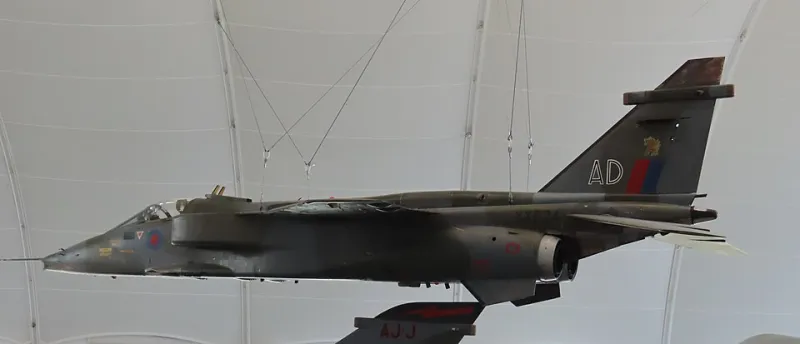
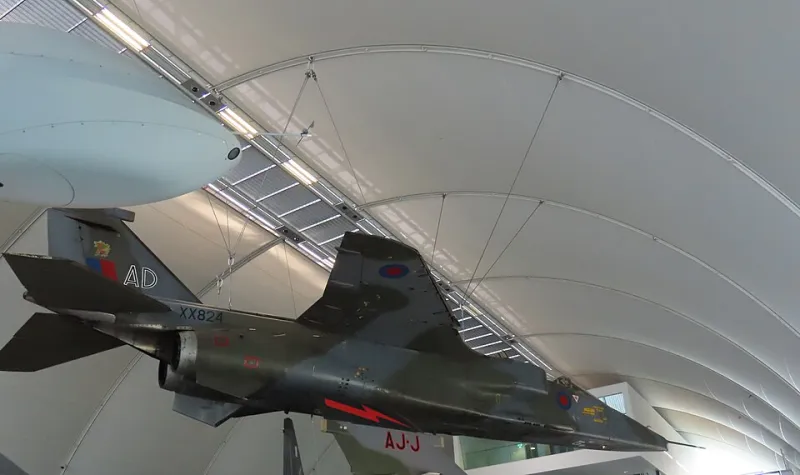
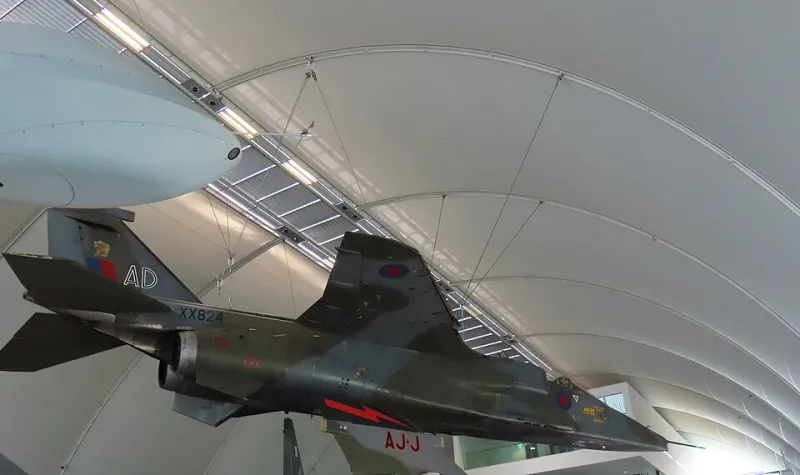
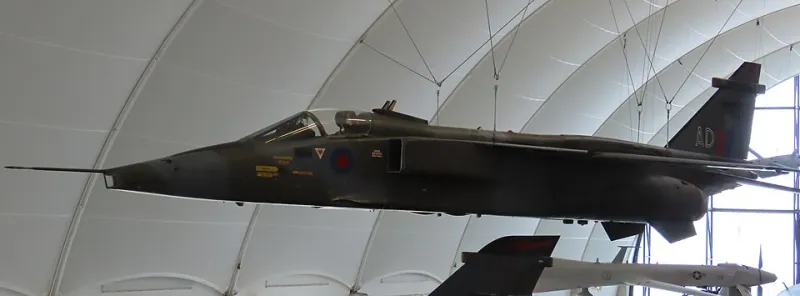
Photo: [[User:Ad Meskens|Ad Meskens You are free to use this picture for any purpose as long as you credit its author, Ad Meskens. Example: © Ad Meskens / Wikimedia Commons If you use this work outside of the Wikimedia projects, a message or a copy is
The Jaguar is usually discussed in terms of what it could carry and how low it could fly. Both are fair measures of the type. Neither, on its own, explains how crews were expected to survive in airspace where radar-guided threats were the defining hazard of the era. That answer sits in a less photographed part of the airframe: the antennas, receivers, dispensers and, above all, the procedures that made up the aircraft's electronic warfare fit.
The receiver as the first sensor
For most of its RAF career the Jaguar's primary electronic defence was passive. The aircraft listened before it looked. A radar warning receiver installation, progressively updated across the GR1, GR1A and GR3 standards, used antennas mounted around the airframe to detect and characterise emissions, presenting the crew with azimuth information and a rough classification of the threat. In a single-seat low-level sortie, that display was often the first indication that anything on the ground had noticed the aircraft at all.
The value of the installation lay less in its sophistication than in its discipline. A receiver does not defeat a threat; it buys seconds. Crews describe the practical skill as one of interpretation rather than reaction, reading a symbol's behaviour, its persistence and its relation to the aircraft's own track, and deciding whether the correct response was to descend, to turn, to dispense, or simply to continue. Later fits improved the library of recognised emitters and the clarity of the presentation, but the fundamental task remained the same from the late 1970s to the final sorties in 2007.
Chaff, flares and the dispenser question
The Jaguar's expendable countermeasures were, for much of its service, a compromise between aerodynamic cleanliness and practical necessity. Chaff was typically carried in the Phimat dispenser, a slim pod mounted on an outer wing station, which offered a substantial magazine of cartridges at the cost of a store station and a measurable drag penalty. Flare dispensers fitted to later airframes addressed the infrared threat, a growing concern as shoulder-launched and vehicle-mounted systems proliferated.
What is striking, reading the archive's maintenance and stores material, is how quickly countermeasures became a matter of load-planning politics. A Phimat pod occupied a pylon that might otherwise have carried a fuel tank or a weapon. On a long low-level sortie the argument between range, payload and protection was settled differently by different crews on different days. Veterans recall the dispenser being treated less as a fixed fitting than as a decision made at the arming line, and defended or regretted afterwards in the debrief.
The jamming that was not there
The RAF never fielded a dedicated Jaguar electronic attack variant. The aircraft carried no integral active jammer of consequence, and the force's answer to a high-threat environment was structural rather than airborne: route away from it, fly beneath it, or accept that the mission belonged to somebody else. Where jamming support existed, it came from outside the Jaguar community, and crews planned on the assumption that it might not arrive.
That absence is easy to read as a deficiency. It is more accurate to read it as a design assumption. The Jaguar was built for a specific band of the threat spectrum, and its electronic protection was sized to that band. Judged against an aircraft expected to penetrate a fully alerted, dense, mobile air defence system, the fit looks thin. Judged against its actual tasking in Germany and on expeditionary operations, it looks proportionate, provided the tactics held.
Switch discipline and the debrief
The most revealing accounts from aircrew concern not the equipment but the habits around it. The receiver had to be managed: sensitivity settings, the temptation to desensitise a display that had become cluttered, the judgement of when a warning was a threat and when it was a neighbouring emitter. Crews speak of the audio tone in the headset as much as the visual symbol, and of the way a familiar emission could become background noise on the fourth hour of a long sortie.
Debriefs turned that experience into institutional knowledge. Tapes and notes were compared, emitter libraries refined, and the difference between a confident crew and a careless one often came down to how honestly they described what the box had told them. In this sense the Jaguar's electronic shield was maintained on the ground as much as in the air.
Compared with its contemporaries
The Jaguar's protection sat in the middle of its generational field. It was more comprehensive than the simpler fits carried by some light strike types, and less capable than the dedicated suppression aircraft that emerged during the 1980s and 1990s. Its closest RAF comparison is instructive: the Tornado carried a heavier and more elaborate defensive suite, reflecting a different cost and a different role, while the Harrier force faced similar problems with comparable compromises.
What distinguished the Jaguar was not the sophistication of any single box but the coherence of the package. Receiver, dispenser, tactics and training were matched to one another and to the threat the force realistically expected. The quiet shield was never going to make the aircraft invisible. It was designed to make the crew's decisions better informed, and on that measure it earned its place in the airframe.