Drag as Doctrine: The Braking Parachute in RAF Jaguar Landing Practice
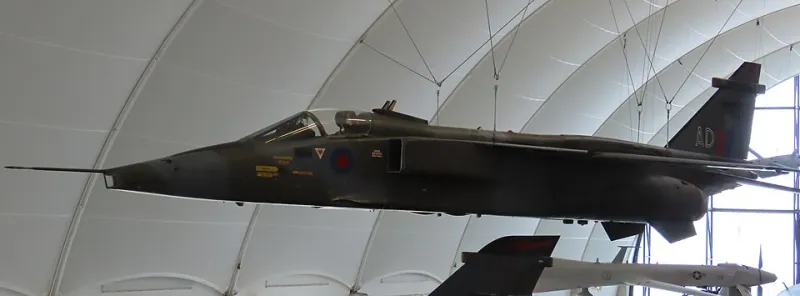
Photo: [[User:Ad Meskens|Ad Meskens You are free to use this picture for any purpose as long as you credit its author, Ad Meskens. Example: © Ad Meskens / Wikimedia Commons If you use this work outside of the Wikimedia projects, a message or a copy is
Among the SEPECAT Jaguar's many systems, the braking parachute occupies an odd position: unmistakable in a landing photograph, yet rarely treated as more than a footnote in accounts of the type. In RAF service, however, the installation was operational equipment in the fullest sense. It extended the aircraft's practical runway envelope, influenced landing technique and imposed a recurring ground-crew task that was as much a part of squadron life as fuelling or arming.
A Tail-Mounted Brake
The RAF Jaguar carried its braking parachute in a bay at the base of the fin, within a distinctive tail fairing. The arrangement was compact and unobtrusive from most angles, which helps explain why the system is often overlooked in general descriptions of the airframe. In use, the pilot deployed the chute after touchdown through a cockpit control; a smaller pilot chute extracted the main canopy, whose drag supplemented wheel brakes and aerodynamic braking during the landing roll. The canopy could be jettisoned before the aircraft cleared the runway, leaving the ground crew to recover it.
The parachute did not alter the Jaguar's approach speed, nor did it replace the wheel brakes. Its value lay in reducing the distance and brake energy required after the aircraft had settled on the runway. For a type that could return with external tanks, reconnaissance pods or unexpended stores, that margin mattered. A heavy landing weight, a wet surface or a short runway all changed the arithmetic of stopping, and the chute gave crews a way to manage it without relying solely on carbon brakes and reverse thrust.
Landing Arithmetic and Drill
In squadron practice, the braking parachute was woven into the landing sequence rather than treated as an emergency device. Crews armed and deployed it according to prescribed drills, with attention to speed limitations, crosswind effects and the need to maintain directional control as the canopy inflated. Deployment too early or in an untidy attitude could produce a sharp deceleration or a swing; deployment too late reduced the available runway margin. The system therefore demanded discipline, not merely a tug on a handle.
At the operational conversion unit, the chute formed part of the wider education in landing a relatively heavy, high-performance strike aircraft. Students learned that the parachute was a planning tool as much as a cockpit action: it affected the decision to accept a runway, the choice of braking technique and the point at which the aircraft could be considered safely under control. The same logic applied on squadrons, where a routine landing with a full complement of stores could become a carefully managed event on a damp autumn day.
Packing, Deployment and Recovery
For ground crews, the braking parachute meant recurring, exacting work. The canopy had to be inspected, aired, folded and packed to a standard that would allow clean deployment; the associated lines, pilot chute and release mechanism required checking; and the installation had to be made ready before flight. Packing was not a task that rewarded haste. A poorly folded canopy could stream badly, damage itself or fail to produce the expected drag.
Recovery was equally part of the rhythm. After a landing, ground personnel would collect the canopy from the runway or taxiway, inspect it for damage and return it to the parachute bay for repacking. Wet weather added drying time; a long landing roll added distance to walk. Former ground crew describe the task in practical terms: the weight of the canopy when wet, the smell of nylon and the need to keep the lines clear of vehicles and aircraft movements. It was unglamorous work, but it kept the landing envelope available.
Base Planning and Runway Choice
The parachute also had a place in base planning. Runway availability was never simply a matter of length; it involved braking action, surface condition, obstruction clearance and the expected landing weight of returning aircraft. The Jaguar's chute gave commanders and crews an additional means of managing those variables. At Coltishall, the home of the Jaguar force for much of its RAF life, and at RAF Germany's front-line stations, the system supported operations from runways that might be wet, contaminated or, in a wartime scenario, damaged.
In RAF Germany, where dispersal and short-field operations were part of the Jaguar force's reason for being, the braking parachute fitted the wider philosophy of reducing dependence on long, vulnerable runways. It did not make the Jaguar a STOL aircraft, but it contributed to the type's ability to operate within a constrained infrastructure. The same thinking influenced squadron engineering: the chute was a consumable and repairable item with its own supply chain, inspection regime and training burden.
Reading the Installation in Photographs
For the enthusiast photographer, the braking parachute installation is a useful identification feature and a source of operational context. The tail fairing at the base of the fin is the primary visual clue; in some archive images it appears as a distinct cylindrical or tapered housing, while in others the bay doors or attachment points are visible during maintenance. Wartime and exercise photography often shows the canopy streaming behind the aircraft after touchdown, particularly on wet runways or when landing with external stores.
Archive images can also reveal absence. A Jaguar photographed without its parachute installation may be a preserved airframe, a maintenance case or an aircraft operating under a different configuration. Landing photographs taken in poor weather, with long ground rolls and ground crew waiting near the runway, are strong evidence of the system in routine use. For researchers, the chute is a reminder that operational clues often sit at the edges of the frame: the tail fairing, the trailing canopy, the recovery team and the runway surface itself.
A Quiet Legacy
The braking parachute was retired with the RAF Jaguar, and many preserved airframes no longer carry a complete installation. Its significance lies in what it says about the aircraft's design philosophy. The Jaguar was conceived for operation from austere and forward bases, and the chute was one of several systems that turned that ambition into practice. It was never the most celebrated piece of equipment on the airframe, but it shaped landings, drills and ground-crew life in ways that deserve more than a footnote.