A Hook Without a Home: The Jaguar M Trials and the Naval Lessons Buried in the RAF Jet
A French Requirement, a Shared Airframe
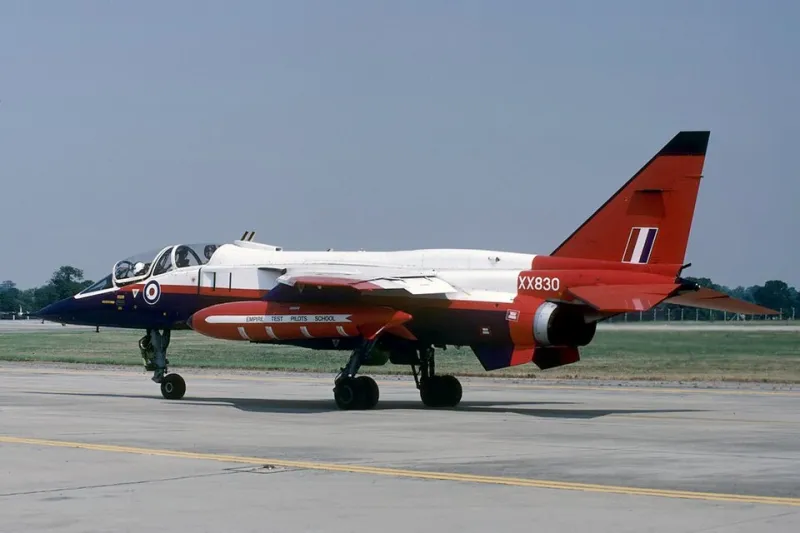
The SEPECAT Jaguar is habitually discussed as a land-based strike aircraft: a low-level machine of dispersed airfields, hardened sites and Central Europe. That identity is accurate, but it is not the whole of the design story. Before the Jaguar settled into RAF squadron service, a navalised branch of the programme was pursued for the French Navy. The Jaguar M was intended to take the same basic airframe to sea, and it was carried far enough to conduct carrier suitability work before the programme was abandoned.
For an archive devoted to the Jaguar, the M matters precisely because it sits just outside the familiar RAF narrative. It was not a paper study. It was an airframe adapted for deck operation, flown in a maritime role and assessed against the very different demands of catapult launch and arrested recovery. Understanding why it failed, and what it left behind, helps explain some of the compromises and qualities built into the RAF's Jaguars.
The Naval Kit
Navalising a land-based aircraft is rarely a matter of adding a hook and painting the airframe in a different colour. The deck environment imposes its own structural and handling requirements: launch loads concentrated through catapult attachment points, recovery loads passed through an arrester hook, corrosion exposure, tight deck handling and a landing approach that must be stable and predictable. The Jaguar M was modified accordingly, with a reinforced undercarriage, an arrester hook installation and the structural provisions needed for carrier operations.
Those changes were significant, but they did not turn the Jaguar into a different aircraft. The M retained the essential Jaguar layout and the Adour engine. That continuity is what makes the variant interesting. It allows the archive to compare a naval adaptation with the land-based production aircraft and to ask which engineering lessons were genuinely maritime and which were simply exposed by the unusual severity of deck trials.
Trials at Sea
The Jaguar M underwent carrier suitability work in the late 1960s and early 1970s, including trials aboard the French carrier Clemenceau. The aircraft was assessed in the conditions that matter most to a naval staff: catapult launches, approach behaviour, arrested landings, deck handling and the practical turnaround of the aircraft between sorties.
Such trials are unforgiving. A land-based aircraft can tolerate a certain vagueness in approach power or brake energy management; a deck aircraft cannot. The pilot must be able to place the aircraft with precision, and the airframe must absorb the repeated shocks of recovery without accumulating damage at an unacceptable rate. The Jaguar M's trials therefore did more than test a hook. They examined the whole aircraft against a demanding operational cycle.
Contemporary assessments pointed to concerns about the single-engine layout and the behaviour of the Adour in the naval environment. Those concerns were not simply matters of engine reliability in the abstract. A carrier aircraft lives or dies by the confidence its crew places in thrust response, wave-off performance and the consequences of a failure at the wrong moment. The Jaguar M could be flown from a deck, but the margin for error was judged too narrow for the French Navy's requirements.
Why the Deck Said No
The cancellation of the Jaguar M in 1971 is often reduced to a technical verdict. That is too tidy. The French Navy's choice of the Super Étendard reflected a mixture of operational preference, industrial politics and budgetary calculation. The Super Étendard was a smaller, more obviously national solution, and it fitted the Navy's carrier plans in a way that the Jaguar M did not.
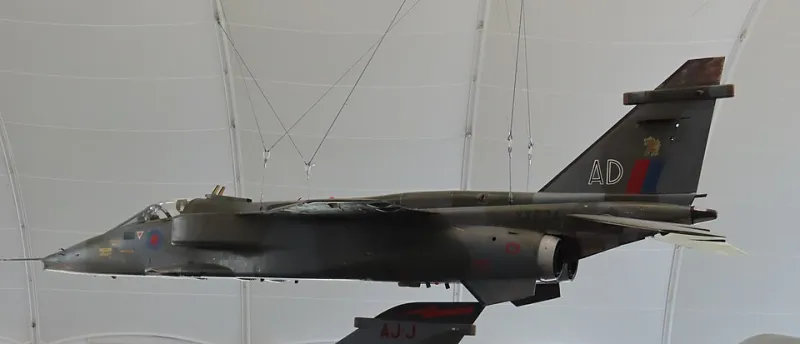
For the Jaguar programme, the consequence was a clean separation. The RAF took the land-based aircraft, while the naval branch ended. No RAF Jaguar carried an arrester hook in squadron service, and no British carrier operated the type. The Royal Navy's fixed-wing carrier story was already moving into a different phase, and the Jaguar's future lay with runways, dispersals and low-level training areas rather than deck markings and catapult tracks.
That separation should not obscure the engineering connection. The Jaguar M was a parallel branch of the same design tree. Its trials generated data and experience about the airframe's behaviour under extreme landing and launch loads, about the practical limits of the undercarriage and about the way the aircraft handled at low speed and high power. Those findings did not transfer as hardware, but they contributed to the common understanding of the Jaguar as a robust and demanding aircraft.
Traces in the RAF Jet
The most visible inheritance is the undercarriage philosophy. RAF Jaguars were not naval aircraft, but they were expected to operate from rough strips and dispersed sites, and their landing gear reflected that requirement. It was strong, carefully packaged and designed to absorb the kind of treatment that a purely runway-bound aircraft might never see. The naval variant pushed a similar logic further, and the comparison is useful when reading the production Jaguar's proportions.
Less visible is the handling knowledge. The Jaguar's approach characteristics, thrust response and braking demands were all part of the M assessment. A pilot converting to the RAF Jaguar encountered an aircraft with a distinctive low-level ride and a landing behaviour that rewarded firm handling. The naval work did not create those characteristics, but it exposed them in a particularly unforgiving setting.
The M also serves as a caution against overstating naval ancestry. The RAF Jaguar was not a carrier aircraft manqué. It lacked the hook, the catapult points and the corrosion regime of a true deck machine. Its inheritance is better described as a set of engineering lessons and structural margins, not a hidden naval capability. The hook had no home in RAF service; the understanding of the airframe did.
The Archive View
The Jaguar M is often treated as a footnote, a French diversion before the main RAF story begins. This archive prefers to see it as a stress test. It showed what the Jaguar could do when asked to meet the sea, and it showed where the design's limits lay. The deck that never was still tells us something about the aircraft that was.