The Reach Behind the Probe: Tanking and the RAF Jaguar's Operational Radius
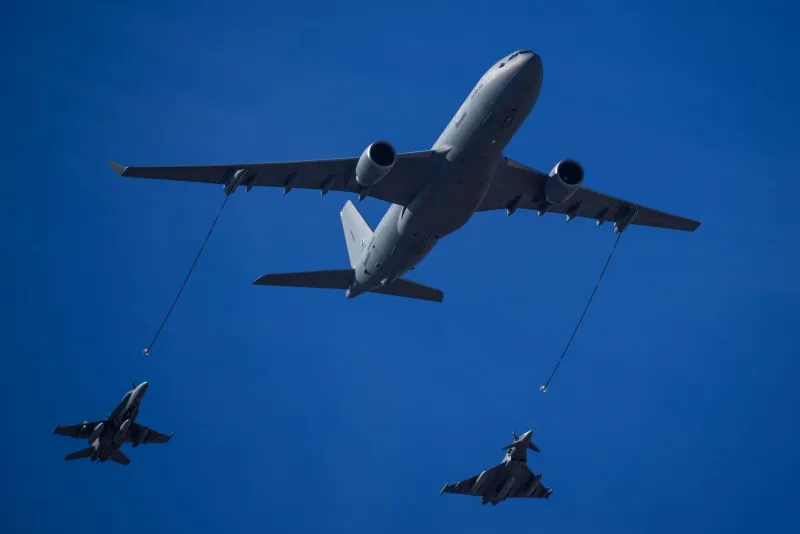
The RAF Jaguar is usually remembered for what it carried and how low it flew. Less often examined is how it got there. Air-to-air refuelling was not an accessory to Jaguar operations; it was the mechanism by which a compact, fuel-limited strike aircraft became a deployable national asset. The fixed probe on the forward fuselage was a permanent statement of intent, but the real system lay in the planning cells, tanker schedules and cockpit workload that surrounded it.
A Fixed Point on the Nose
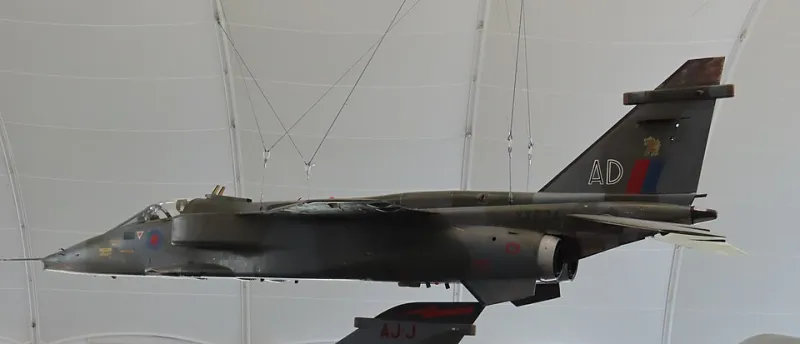
The Jaguar's refuelling probe was not a retractable refinement. It was a fixed installation on the forward fuselage, conspicuous in photographs and unmistakable in the walk-round. That simplicity suited the aircraft's design philosophy: the probe added little mechanical complexity, but it demanded discipline from the crew. There was no hiding it away after use, and no mechanism to blame when the connection failed. The receiver had to be flown to the hose.
For the RAF, probe-and-drogue refuelling was the standard method, and the Jaguar sat within a broader national system rather than a bespoke one. The probe's position affected visibility and approach geometry, and pilots practised the offset sight picture until it became second nature. In a single-seat Jaguar, with the workload of low-level navigation and weapons delivery already high, refuelling had to be rehearsed to the point of routine. The two-seat training aircraft offered a useful instructional platform, but the operational aircraft left little room for improvisation.
Fuel as a Planning Discipline
Internal fuel set the shape of a sortie; refuelling set its ambition. Jaguar crews thought in terms of fuel states, diversion airfields and tanker timings rather than a single range figure. A low-level profile consumed fuel rapidly, and the difference between a viable mission and an abandoned one often lay in a planned receiver bracket rather than in any headline radius.
External tanks extended endurance, but they also imposed drag and store limitations. The planning problem was therefore not simply how much fuel could be carried, but when and where it could be taken on. A tanker rendezvous could turn a short-range strike into a longer deployment, but it also introduced a fixed point in the mission that weather, traffic and tanker availability could disrupt. Fuel management became a form of tactical planning: reserves were protected, brackets were respected and the return to a tanker was treated as part of the sortie rather than an emergency.
Tankers in the Chain
The RAF's tanker fleet changed over the Jaguar's service life, and each type brought its own characteristics to the receiver's task. The Handley Page Victor K.2 was the tanker of the Jaguar's earlier operational years, a large and capable platform whose hose drum units supported a generation of RAF receivers. The Vickers VC10 tankers that followed offered a different set of arrangements, including three-point tanking on some variants, while the Lockheed TriStar broadened capacity and range still further.
For Jaguar crews, the tanker was not a background asset. It was a formation partner with its own speed, altitude and hose behaviour. The approach to a Victor or VC10 drogue demanded a stable formation and a clear understanding of the tanker's limitations. In a mixed package, the Jaguar's fuel needs had to be balanced against those of other receivers, and the tanker crew's task was to deliver fuel without turning a rendezvous into a congestion problem.
The result was a chain of dependency. A Jaguar deployment to the Gulf in 1990-91, or a Balkan sortie in the following decade, depended on tanker aircraft that were themselves in demand. Refuelling made the Jaguar deployable, but it also tied the force to a scarce and highly scheduled resource.
The Crew's Share of the Hose
Public accounts of refuelling often concentrate on the hardware. In the cockpit, the task was one of workload management. The pilot had to join a formation, stabilise behind the hose, make contact and then hold position while fuel transferred. In a single-seat Jaguar, this competed with navigation, communications and threat awareness. The probe's fixed geometry meant the sight picture was consistent, but consistency did not make the task effortless.
Crews practised dry contacts and full refuelling sorties, and the two-seat Jaguars allowed instructors to observe the approach and correct habits before a pilot reached the operational squadron. The aim was not merely to pass fuel. It was to make the receiver's behaviour predictable enough that the tanker crew could do their job without unnecessary correction. A good Jaguar tanking sortie was uneventful by design.
Reach, Not Range
The Jaguar's reputation as a short-legged aircraft is fair in terms of internal fuel, but incomplete as an operational judgement. Range is a property of the airframe; reach is a property of the system. With tanker support, the Jaguar could be moved to a theatre, sustained in a forward posture and employed on sorties that its internal fuel alone would not have allowed. Without that support, its utility contracted sharply.
This distinction matters for how the force is remembered. The tanker fleet was not a supporting detail. It was part of the Jaguar's operational architecture, and the aircraft's probe was the visible end of a much longer chain. In 2026, preserved Jaguars still carry that probe, often as the most obvious reminder that the aircraft was built to be more than a local striker.
An Under-Examined Chapter
Tanking is difficult to photograph well and easy to reduce to a technical footnote. Yet the Jaguar's service record cannot be understood without it. The fixed probe, the fuel planning, the tanker formations and the cockpit discipline together produced a reach that the bare airframe did not possess. For an archive devoted to the Jaguar, that is more than a detail of equipment. It is a chapter in how the aircraft was actually used.