Borrowed Parts: Cannibalisation and the Hidden Maintenance Economy of the RAF Jaguar
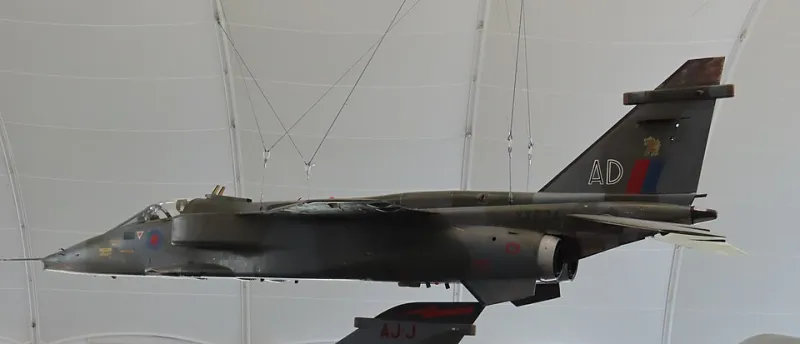
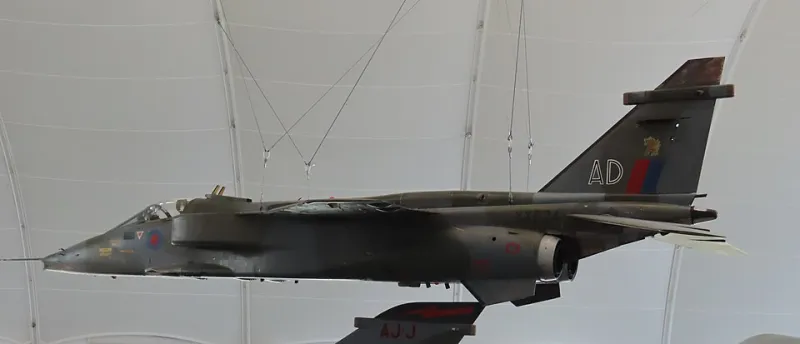
Photo: [[User:Ad Meskens|Ad Meskens You are free to use this picture for any purpose as long as you credit its author, Ad Meskens. Example: © Ad Meskens / Wikimedia Commons If you use this work outside of the Wikimedia projects, a message or a copy is
The RAF Jaguar is usually discussed in terms of low-level attack, reconnaissance pods and the distinctive silhouette that became familiar at Coltishall and in Germany. Yet the force's day-to-day health depended on a less photogenic subject: the movement of serviceable parts between airframes. As the fleet contracted, spares provisioning, rotable pooling and cannibalisation became central to whether a squadron could meet its flying programme. Understanding that maintenance economy is essential to any honest account of the Jaguar in its final years.
The arithmetic of a smaller fleet
A shrinking fleet does not simply reduce maintenance demand in proportion. It changes the economics of support. Fixed costs remain, repair lines may close, and the pool of donor aircraft can become both an asset and a warning sign. During the Jaguar's later RAF service, the type operated under the pressure of ageing equipment, finite spares and a drawdown that made long-term provisioning difficult to justify. The result was a maintenance system that had to be inventive with what it had.
Cannibalisation — often described in squadron language as robbing or borrowing — was the controlled removal of a component from one aircraft to restore another to service. It was not an admission of failure so much as a response to scarcity. If a fuel pump, actuator or line replacement unit was unobtainable through the normal supply chain, a decision had to be made: ground one aircraft for the long term, or take a serviceable item from it so that another could fly. Maintainers and engineering authority staff weighed those choices against the flying task, the modification state of the airframes and the likely repair timescale.
Rotables, pools and the limits of paperwork
Rotable components formed the backbone of Jaguar availability. Engines, gearboxes, hydraulic assemblies and avionics boxes were designed to cycle between aircraft, repair and overhaul. In theory, a rotable pool gives a fleet resilience: one item can support several airframes over time. In practice, the pool only works when depth-level repair can return items at a predictable rate. When repair turnarounds lengthen, the pool drains, and the pressure moves to the line.
That pressure was felt most acutely at squadron level. A serviceable rotable might be held at base, within a station pool or further back in the supply system. Each move required documentation, and each documentation trail had to be credible. Jaguar maintainers were not merely swapping metal; they were managing a chain of accountability that linked the aircraft, the component record and the engineering authority. A part that fitted physically might still be unsuitable because its modification state or service life did not match the receiving airframe.
Configuration: the invisible constraint
The Jaguar fleet was not a single homogeneous block. GR1, GR1A, GR3 and GR3A standards, together with two-seat variants, reflected different roles and successive upgrade programmes. Even within a broadly similar standard, individual aircraft could differ in modification state, wiring, software and equipment fit. That mattered when cannibalisation was considered. A component cleared for one aircraft might not be cleared for another without engineering assessment.
Configuration control therefore sat at the centre of the maintenance economy. It was not enough to find a part that looked right. The maintainer had to establish that it belonged to the correct part number and modification standard, that its history was known and that its installation did not create a new defect or invalidate a clearance. In a fleet under spares pressure, those checks could become a source of friction: the quicker the turnaround demanded, the greater the temptation to rely on experience rather than paperwork. The system depended on discipline.
The complication was not abstract. A Jaguar configured for reconnaissance duties, or one carrying a particular stores or avionics fit, could not simply be treated as interchangeable with every other airframe. Cannibalisation had to respect those differences. The consequence was a form of maintenance triage: some aircraft were kept at a high standard for operational or training tasking, while others became donors whose own return to service was deferred.
The trade-offs maintainers made
Cannibalisation bought flying hours in the short term, but it carried costs. Removing a component from an otherwise sound airframe created a future work package. It could also obscure fault trends: if a box was repeatedly borrowed, was the problem the box, the aircraft wiring or the installation? Maintainers had to distinguish between a genuine component failure and a symptom created by repeated transfers. Good engineering judgement mattered as much as supply-chain reach.
The trade-off was especially sharp in the final decade of RAF Jaguar operations. With retirement on the horizon, major investment in repair capacity or new spares was difficult to defend. Yet the force still had commitments and training requirements. The result was a delicate balance between sustaining the active fleet and preserving enough donor material to keep it going. Decisions that looked short-sighted in isolation often reflected a rational reading of a fleet with a finite life ahead of it.
Depth support and the long shadow
Line maintenance could only do so much. Depth-level support — the heavier repair, overhaul and modification work carried out behind the squadron — determined how quickly rotables returned and how much confidence the front line could place in the pool. When depth support was efficient, cannibalisation remained an exception. When it was stretched, borrowing became routine.
The long shadow of that arrangement is still visible in the preserved fleet. Surviving Jaguars may carry non-standard fits, missing components or documentation that reflects a life of part exchange rather than tidy originality. For archivists and enthusiasts, those details are not flaws to be ignored. They are evidence of how the aircraft were actually sustained.
Why the hidden story matters
The Jaguar's operational record rests on sorties, squadrons and exercises, but those activities were underwritten by a maintenance economy that rarely appeared in the headlines. Spares scarcity, rotable pooling, configuration control and cannibalisation shaped availability long before an aircraft reached the runway. They also shaped squadron morale: maintainers knew which airframes were fragile, which parts were scarce and which compromises had already been made.
To study the RAF Jaguar without that context is to see only the finished product. The borrowed parts, the deferred defects and the carefully managed donor aircraft explain why the force could still function as it contracted. They are part of the type's technical history, and part of the reason its final years deserve close attention.