The Sound as Artefact: Why a Running Jaguar Beats a Static One
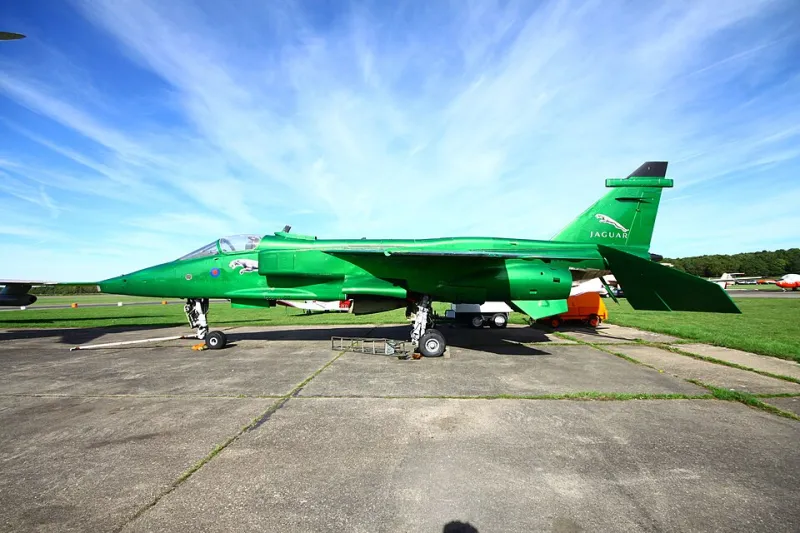
Photo: Paul Lucas from Leicestershire, UK, CC BY 2.0, via Wikimedia Commons
A static Jaguar preserves shape. It preserves paint, panel lines, squadron markings and the particular geometry of a strike aircraft designed for low-level work. What it does not preserve is the thing that made the aircraft a living machine: sound, heat, smell and the disciplined choreography of a ground run. In 2026, Britain should support at least one credible taxiable or ground-running Jaguar. The case is not nostalgia. It is about interpretation, skills and the difference between an object and an artefact in working order.
What the glass case cannot show
A museum visitor can read that the Jaguar was powered by two Rolls-Royce Turbomeca Adour engines. That is information. Hearing an Adour start, settle and run is understanding. The sound carries the density of the aircraft: the starter cycle, the rising note, the heat shimmer, the smell of fuel and oil, the sudden seriousness of a machine that is no longer a display. For an aviation archive, that sensory record is part of the history.
A ground-running exhibit also creates a natural audience for engineering explanation. Visitors can see why intake blanks matter, why fire cover is positioned, why chocks and restraints are checked, and why a run crew works to a schedule. The aircraft becomes a system with procedures rather than a sculptural object.
The engineering reality
A ground run is not a flight, but it is not a trivial demonstration either. The airframe must have serviceable engines, fuel, oil, hydraulic and electrical systems, brakes and fire suppression. A gate guardian that has stood outdoors for years is unlikely to be a suitable starting point without major inspection and replacement work. Corrosion, wiring degradation, seal condition and engine storage history all matter.
The sensible model is not 'restore to fly'. It is 'restore to run'. That distinction controls cost and risk. A ground-run Jaguar does not need airworthiness for flight, but it does need a documented engineering baseline. The project should begin with a systems survey, a structural assessment and an honest spares audit. If the engines cannot be supported, the project should stop before money is spent on cosmetics.
Safety and governance
Any ground-running project needs a safety case that a museum, an airfield and an insurer can accept. That means defined exclusion zones, fire cover, fuel handling procedures, intake and exhaust safeguards, restraint arrangements and a clear command structure. Ejection seats should be inert or appropriately controlled. Canopies, ladders and access panels need disciplined management.
The governing framework depends on where the aircraft is based. A military site, a civil airfield and a museum apron will each impose different requirements. The project should not pretend that enthusiasm substitutes for regulation. It should appoint an engineering control board with named responsibilities, keep training records for volunteers, and write procedures that a regulator or insurer can inspect.
Skills, volunteers and money
The volunteer angle is one of the strongest arguments for a running exhibit. Britain has a deep pool of former RAF ground crew, engine trades, electricians and airframe technicians whose skills are otherwise retired with them. A ground-run project gives those skills a purpose and a transmission route to younger volunteers. It also creates a reason to collect technical documentation, tooling and spares that might otherwise be dispersed.
Funding is the harder part. Engine hours are finite, spares are scarce and hangarage is expensive. A credible project should not promise frequent public runs. It should plan a small number of demonstration days, supported by membership, grants, corporate sponsorship and museum admission. The aim is sustainability, not spectacle. A Jaguar that runs once a year under proper control is worth more than a promise of weekly taxy displays that exhausts the team and the spares.
A credible route for 2026
A practical proposal would proceed in phases. Phase one is a static restoration and systems survey, with public interpretation explaining what is being assessed. Phase two is dry motoring or equivalent system checks where technically appropriate. Phase three is a first ground run under controlled conditions, with no public audience beyond the project team and regulators. Phase four is a limited programme of public run days.
The project should choose one airframe with a complete identity and a documented history. It should partner with an established museum or collection and an airfield that can provide fire cover and space. It should publish its engineering standards, not just its aspirations. And it should be willing to say 'not yet' when a system is not ready.
The case in one sentence
Britain does not need a flying Jaguar to remember the type. It needs a working one. A ground-running Jaguar would preserve the sound, the procedures and the skills that static airframes cannot, and it would give the next generation of enthusiasts something rarer than a photograph: a machine that is allowed to be itself, briefly, on the ground.