Showpiece Strike: The Jaguar's Airshow Life and What It Left on the Crowd Line
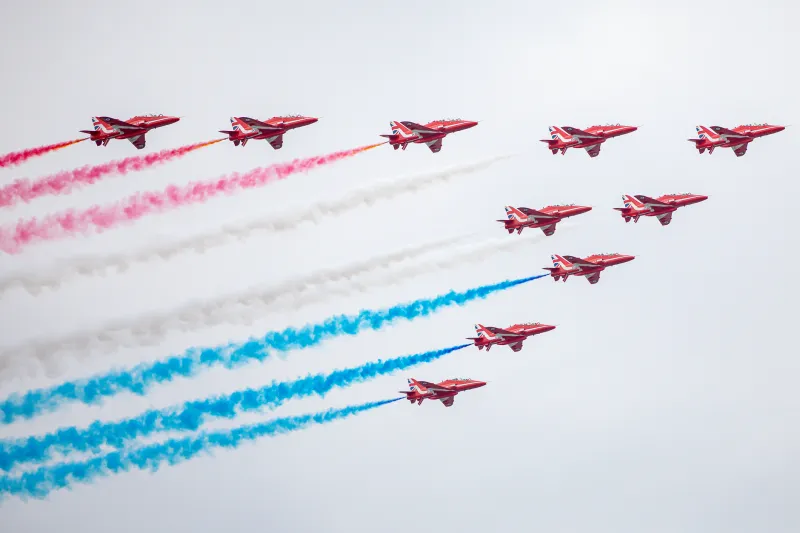
For a strike aircraft, the airshow is an unnatural stage. The SEPECAT Jaguar was designed to arrive low, fast and laden, to use terrain and timing rather than aerobatic elegance, and to disappear again before an enemy could organise a response. Yet for a long stretch of its RAF career the type was also expected to perform a very different duty: to turn up at a British airfield on a summer weekend, hold the crowd's attention for several minutes and leave behind a favourable impression of the Royal Air Force.
That second career is easily reduced to a list of paint schemes and display serials. It deserves more. Display flying was a public argument about what the Jaguar was—and, just as often, about what the RAF preferred the public not to dwell on.
The Display Jet as a Borrowed Airframe
The RAF did not generally maintain a permanent Jaguar display team in the manner of the Red Arrows. Display aircraft were usually borrowed from the operational force or the conversion unit, prepared for the season and then returned to more prosaic duties. The pilot was similarly seconded: a squadron or training officer with the experience to keep a display safe within a tight box of height, speed and weather minima.
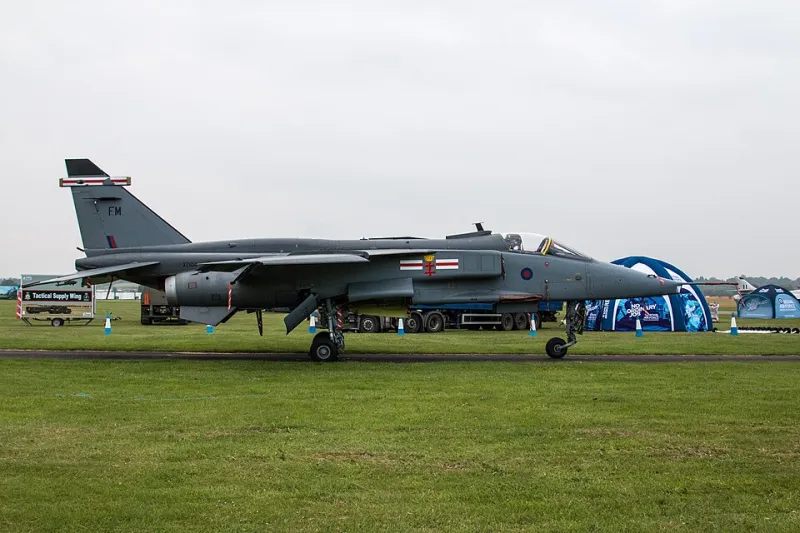
This mattered to the character of the performances. A display Jaguar was not a specially lightened show machine. It remained a military aircraft with military systems, military paint and military paperwork. The difference was one of presentation. Panels were cleaned, paint was touched up, and the aircraft was configured for the crowd rather than for a war load. In photographs from the period, the display jet often looks almost ordinary—until the markings, the finish and the setting identify it as the day's centrepiece.
Markings, Finish and the Photographer's Problem
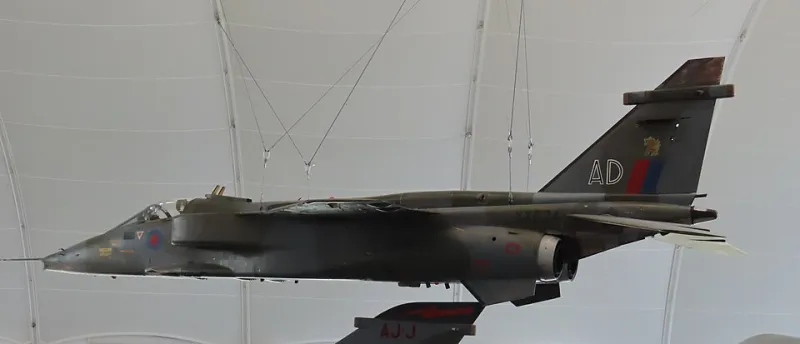
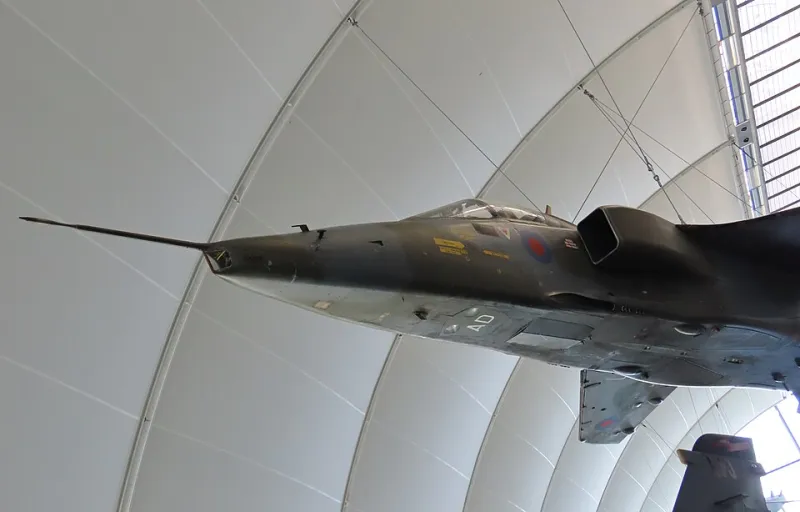
The Jaguar's RAF colours changed with the force's own evolution. Early aircraft wore the dark green and dark sea grey camouflage associated with the Cold War battlefield, with light aircraft grey undersides. Later machines adopted wraparound schemes, and the post-Cold War grey finish gave the type a cooler, more clinical appearance. Display aircraft followed those changes, but they also carried the accumulated sign language of squadron life: crests, bars, anniversary tail markings and station identities.
For photographers, this created a familiar problem. A Jaguar on static display could look anonymous in a programme but highly specific under the lens. The top surfaces told one story, the nose and tail another. Crowd-line pictures often caught the aircraft in a bank or a climb, revealing the upper-wing camouflage and the fin markings that a level pass would hide. The best display photographs are therefore not simply records of an aircraft in the air; they are records of an airframe's identity at a particular moment in its service.
The Routine: Speed, Height and the Illusion of Simplicity
A Jaguar display routine was built around the aircraft's strengths rather than around fighter-style agility. The type had no afterburner; its Rolls-Royce Turbomeca Adour engines produced a purposeful, flat roar rather than the rising crescendo of a fighter. The display made capital of acceleration, low-level stability and the sheer visual mass of a twin-engine strike aircraft passing close to the crowd line.
A typical sequence might include a clean take-off, a steep climb, a series of passes in different configurations, a dirty pass with undercarriage and flaps extended, and a final high-speed run before landing. The exact figures varied by pilot and season, but the grammar was consistent: establish the aircraft, show its speed, show its docility, and leave the crowd with a sense of controlled power.
What the routine revealed was real enough. The Jaguar was stable, robust and remarkably steady in low-level flight. Its undercarriage and handling made it well suited to the austere operating patterns that defined its operational life. What the routine concealed was equally important. A clean display aircraft said little about the type's principal burden: the navigation, targeting and weapons work that made it a strike machine rather than a demonstration mount. The crowd saw the airframe; the operational Jaguar was defined by what hung beneath it and by the crew work inside it.
Role Demonstrations and the Martial Turn
From the 1980s onwards, British airshows increasingly favoured role demonstrations over pure solo displays. These were choreographed presentations of military capability: multiple aircraft, simulated attacks, pyrotechnics and commentary that explained the action to the public. The Jaguar force took part in this format, using pairs or small formations to suggest the tempo and coordination of front-line operations.
Role demonstrations were more revealing than solo routines, but they were still theatre. The aircraft flew profiles that were safe, repeatable and legible from the crowd line. The explosions were placed; the timings were rehearsed. What the public saw was not a typical sortie but a compressed and sanitised version of one. Even so, the format gave the Jaguar a martial presence that a solo display could not. It reminded spectators that this was an aircraft designed to operate in formations, at low level, with a logistical tail behind it.
What the Crowd Did Not See
Display flying put the Jaguar in front of the public, but it did not show the work that sustained it. The engineering effort, the turnarounds, the squadron politics and the operational pressures of RAF Germany or Coltishall were largely invisible. A display aircraft was a clean, photogenic representative of a force that spent most of its time preparing for a war that never came.
That gap between appearance and function is one reason the Jaguar's display career remains interesting. The aircraft was often described in the press as a bomb truck, yet its display persona was that of a precise and disciplined performer. Both descriptions were partial. The display showed the airframe's manners; the operational record showed its purpose.
The 2026 View
In 2026, the Jaguar's display era survives chiefly in programme scans, slide collections and the paint histories of preserved airframes. Enthusiasts can still trace the lineage of individual aircraft from squadron service to display duties and, in some cases, to museum or private preservation. The markings are often the best evidence: an anniversary tail or a station crest can fix an airframe to a specific season and a specific public appearance.
For the archive, the value of display photography lies in that specificity. The Jaguar was never a natural airshow star in the way of a nimble fighter, but it was a compelling one: heavy, fast, noisy and unmistakably a product of the RAF's low-level strike tradition. Its display career did not disguise that tradition so much as give the public a carefully framed view of it—close enough to hear, far enough away to keep the secrets.