Airframes in Waiting: A 2026 Field Guide to Britain's Preserved Jaguars
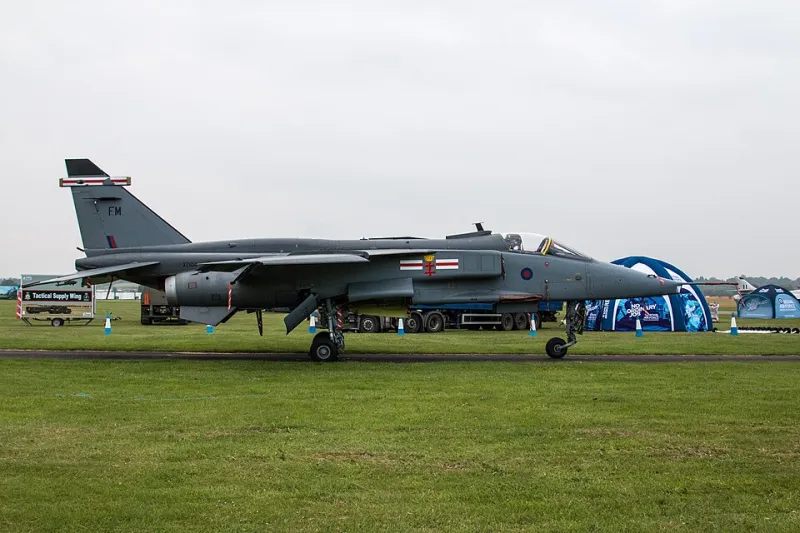
Photo: Steve Lynes from Sandshurst, United Kingdom, CC BY 2.0, via Wikimedia Commons
For an aircraft that left RAF frontline service in 2007, the SEPECAT Jaguar remains unusually present in Britain. Airframes survive indoors and outdoors, in national museums and smaller volunteer collections, and as gate guardians that mark former stations and units. This guide is written for the enthusiast with a camera and a free weekend rather than for the completist seeking every last cockpit section. It surveys the principal public survivors as of 2026, explains what variant and markings visitors are likely to encounter, and offers practical notes on photographing aircraft that are often displayed close to barriers, under mixed lighting or in the open air.
Why the survivors matter
The UK's preserved Jaguars are not a random sample. They trace the type's RAF story: early GR.1 airframes, the upgraded GR.3 and GR.3A strike variants, and the tandem-seat T.2 and T.4 trainers. Several carry squadron markings that evoke the Jaguar force's Cold War and post-Cold War identity, including No. 6, No. 41 and No. 54 Squadron associations, while others reflect station flights or training units. For the photographer, that variety is useful. A GR.3A in a late grey scheme tells a different story from an early GR.1 in camouflage, and a trainer's longer canopy offers a clear view of the tandem layout that shaped the aircraft's Anglo-French design brief.
The distribution of survivors also says something about how Britain remembers military aviation. The largest national collections hold Jaguars as part of broader narratives of RAF strike power, while smaller museums preserve them as local landmarks. Gate guardians occupy a third category: visible from a road or station perimeter, but not always accessible for close photography. Treat all three groups differently.
The public core
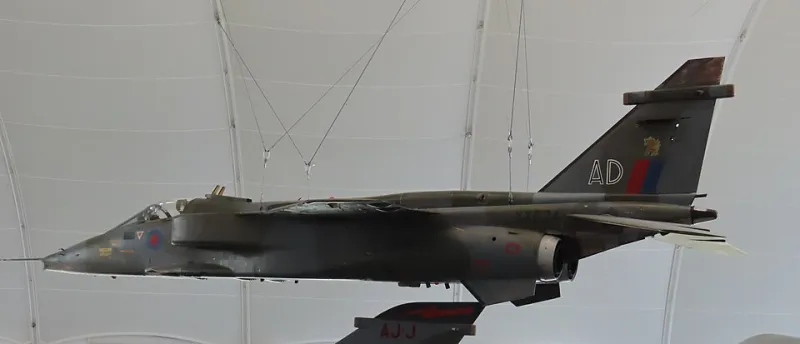
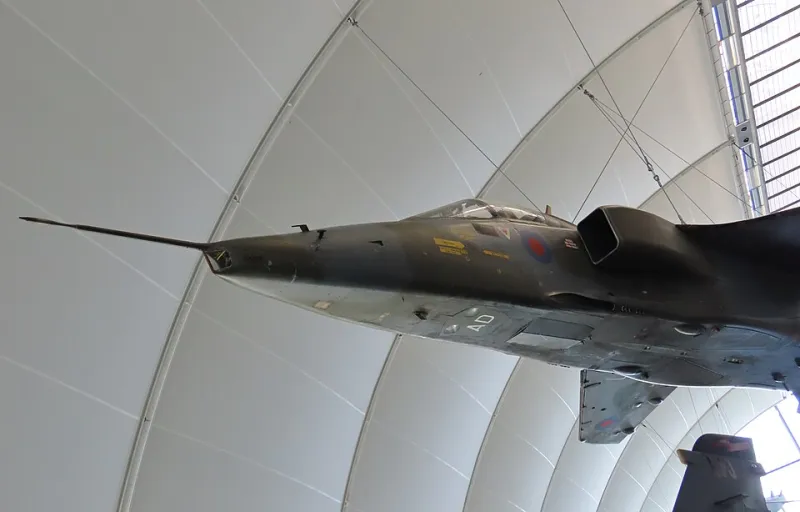
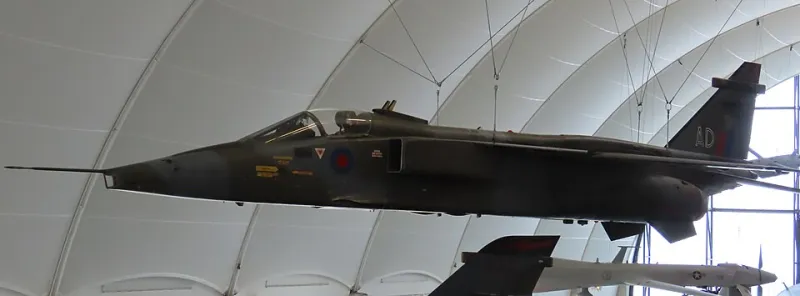
The RAF Museum Midlands at Cosford is the natural starting point. Its Jaguar display sits within a collection that allows the type to be read alongside other RAF strike and training aircraft. Indoor conditions are a mixed blessing: the airframe is protected from the weather, but hangar lighting can be uneven and reflections from glass or polished floors are common. A fast prime lens and a high ISO setting are more useful than a tripod, which may be restricted.
The Imperial War Museum at Duxford offers another major indoor opportunity. The Jaguar in the AirSpace hangar can be studied at close range, but barriers and reflections demand care. Duxford rewards detail work: undercarriage bays, over-wing pylons, the gun pack area and the cockpit canopy all repay close attention. As ever, check the museum's current photography rules before travelling.
Newark Air Museum is a strong choice for outdoor photography. Its Jaguar, a GR.3A example in No. 41 Squadron markings, is displayed in the open, giving relatively clean sightlines and good opportunities for detail shots. The museum's compact layout means the aircraft can be photographed from several angles without a long walk, though background clutter is part of the challenge.
The City of Norwich Aviation Museum holds a Jaguar GR.3A and is particularly associated with the type's East Anglian history. Outdoor display and close access make it a rewarding venue for enthusiasts, but opening hours are limited and should be confirmed. The same advice applies to the Yorkshire Air Museum at Elvington, where the Jaguar is displayed outdoors in an atmosphere that suits the type's rugged, operational character. Wind and flat light are common, so a polarising filter and a careful check of the weather forecast are sensible.
Solway Aviation Museum near Carlisle and the East Midlands Aeropark are further outdoor options. Both are volunteer-run and may display Jaguars alongside other Cold War types. They are less predictable than the national museums, which is part of their appeal, but visitors should always check opening arrangements before setting out. Smaller collections such as the Gatwick Aviation Museum and Morayvia hold Jaguar material or airframes at various times; collections change, so verify before relying on a particular airframe being present.
Gate guardians and private holdings
A number of Jaguars survive as gate guardians or in private storage. These are the least accessible airframes and the easiest to misrepresent. Some are visible from public roads; others are on private land or within active stations. Access is at the owner's discretion. Enthusiasts should write ahead, respect photography restrictions and avoid publishing precise locations of private airframes without consent. A gate guardian photographed from a perimeter fence is not the same as a museum exhibit, and the difference matters.
Private collections also hold airframes in varying states of completeness. Some are used for spares recovery or ground instruction; others are being restored. These are valuable to the historical record but rarely open to casual visitors. The practical rule is simple: never assume that a Jaguar listed in an online database is publicly viewable in 2026.
Variants and markings
The public survivors cover the main RAF variants. The GR.1 represents the original single-seat strike aircraft, with its distinctive high-wing layout and over-wing pylons. The GR.3 and GR.3A reflect later upgrades, including revised nav/attack equipment and, in the GR.3A, uprated Adour engines. The T.2 and T.4 trainers show the tandem-seat arrangement that was central to the Anglo-French requirement. Markings vary from early camouflage to late grey schemes, and squadron badges are a useful guide to provenance. Photographers should record both sides of the airframe where possible: unit markings, serials and nose art are not always symmetrical.
Photographing preserved Jaguars
Indoor Jaguars demand patience. Hangar lighting often produces colour casts, and glass cases or barriers can intrude. Shoot raw where possible, check white balance and use detail crops to isolate the cockpit, intakes and undercarriage. Outdoors, the Jaguar's low-mounted fuselage and high wing can produce deep shadows; side-on views in soft light are usually more revealing than dramatic angles at midday. At gate-guardian sites, long lenses are essential and permission is preferable to improvisation. Above all, remember that these airframes are preserved by volunteers and trusts. Respect barriers, avoid touching the aircraft and support the museums that keep the Jaguar visible.
In 2026 the UK's Jaguar survivors are neither a complete fleet nor a random scatter. They are a distributed archive of the type's RAF career, best read venue by venue and photographed with the same care that the aircraft themselves deserve.