Rails, Stations and Tanks: A Reader's Guide to Jaguar External Stores
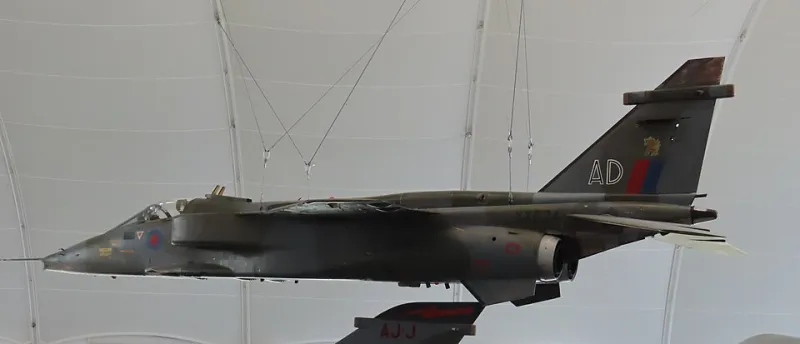
Photo: [[User:Ad Meskens|Ad Meskens You are free to use this picture for any purpose as long as you credit its author, Ad Meskens. Example: © Ad Meskens / Wikimedia Commons If you use this work outside of the Wikimedia projects, a message or a copy is
Period photographs of the SEPECAT Jaguar are often judged by camouflage, squadron markings or airframe detail. For the enthusiast, however, the really useful clues frequently hang beneath and above the wing. The Jaguar's external carriage was compact but flexible, and the fit chosen for a particular sortie can reveal a great deal about role, range and period. This guide is intended as a practical aid to reading those loadouts in photographs.
The Basic Geometry
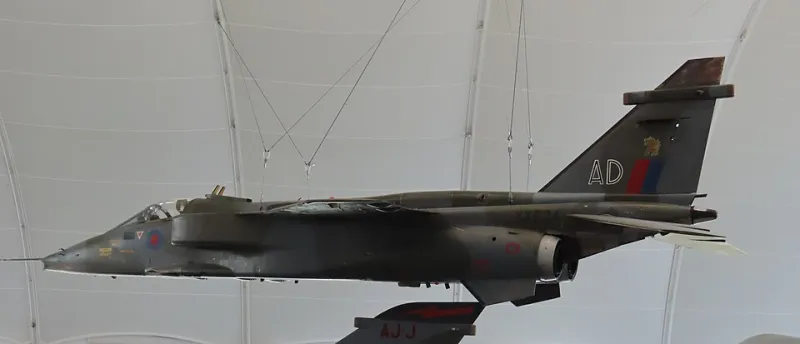
The Jaguar's external stores arrangement was built around a small number of stations. Four underwing pylons carried the main offensive and fuel loads, while a centreline station provided additional fuel or specialist equipment. Above the wing, two overwing rails were fitted for short-range air-to-air missiles. The result was a neat, almost symmetrical arrangement that suited the aircraft's slim fuselage and shoulder-mounted wing.
That simplicity can be deceptive. Each station had its own clearance limits, weight restrictions and release characteristics. A load that looked plausible in a photograph might have been cleared only for specific conditions, and some combinations were never intended for operational use. When examining a period image, it helps to identify the station first, then the store, and finally the context.
Overwing Rails and the Sidewinder
The most distinctive Jaguar feature for many readers is the pair of overwing rails. These carried AIM-9 Sidewinder missiles, typically the AIM-9L in later RAF service. The overwing position kept the missiles clear of the main underwing stores and reduced interference with the wing's aerodynamic flow. It also gave the Jaguar a self-defence capability without occupying a valuable underwing station.
Not every photograph shows the rails fitted. In peacetime training, the overwing positions were sometimes left bare or fitted with acquisition rounds rather than live missiles. A jet with Sidewinders mounted but no obvious offensive stores is often on a transit, training or air-defence exercise sortie. During operations such as Granby, the rails became a more regular feature, reflecting the need for self-protection in a contested air environment.
Underwing Stations: Inboard and Outboard
The four underwing pylons were the Jaguar's principal carrying points. Inboard stations commonly held 1,200-litre drop tanks, which gave the aircraft the range needed for transit and longer sorties. Outboard stations could carry bombs, rocket pods or additional stores, depending on the mission and the weight limits imposed by the fit.
A photograph showing tanks on the inboard stations and bombs or rocket pods outboard usually points to a strike or close air support sortie with range considerations. A clean wing with only small practice stores suggests training. The presence of CRV-7 rocket pods, for example, is a useful indicator of a ground-attack task, while BL755 cluster bombs or 1,000 lb bombs point to a more conventional offensive load. The precise combination often reflects squadron practice, theatre requirements and the stores available on the day.
Centreline Stores and Fuel Tanks
The centreline station was versatile. It could carry a drop tank for additional range or a reconnaissance pod for tactical imaging. The Jaguar's reconnaissance role was important in RAF service, and the centreline pod gave the aircraft a clear field of view without cluttering the underwing stations. In photographs, the recce pod is usually identifiable by its elongated shape and the windows or sensor apertures along its side.
When a Jaguar appears with a centreline recce pod and underwing tanks, the likely task is reconnaissance rather than attack. If the centreline carries a tank and the underwing stations are loaded with offensive stores, the aircraft is probably configured for a longer-range strike or attack sortie. Fuel is always the limiting factor in interpreting Jaguar loadouts: the aircraft was not a large bomber, and tanks were often the difference between a useful sortie and a short one.
Reading a Loadout in Period Photographs
A useful method is to work from the outside in. First, check the overwing rails: are Sidewinders fitted, and are they live or training rounds? Next, look at the underwing stations: are the inboard pylons carrying tanks? Are the outboard pylons loaded with bombs, rockets or nothing? Then examine the centreline: is there a tank or a recce pod? Finally, consider the context: squadron markings, camouflage scheme, location and date can all narrow the interpretation.
A jet with overwing rails, inboard tanks and no offensive stores is likely on a transit or training flight. A jet with tanks, bombs and Sidewinders is configured for a operational attack sortie with self-defence. A jet with a centreline recce pod and tanks is on a reconnaissance task. These are not rigid rules, but they are useful starting points.
Trade-Offs and Visual Clues
Every Jaguar loadout involved trade-offs. More fuel meant more range but greater weight and drag. More weapons meant greater punch but reduced endurance. Asymmetric loads could be carried, but they imposed handling and clearance considerations. The aircraft's landing gear and brake energy limits also shaped what could be recovered at the end of a sortie.
For the photographic researcher, these trade-offs are part of the appeal. The Jaguar's external stores are not merely accessories; they are evidence of planning, doctrine and operational circumstance. Learning to read them turns a static photograph into a record of a particular mission, place and moment in RAF Jaguar history.