The Paint Is the Evidence: Reading RAF Jaguar Camouflage and Markings
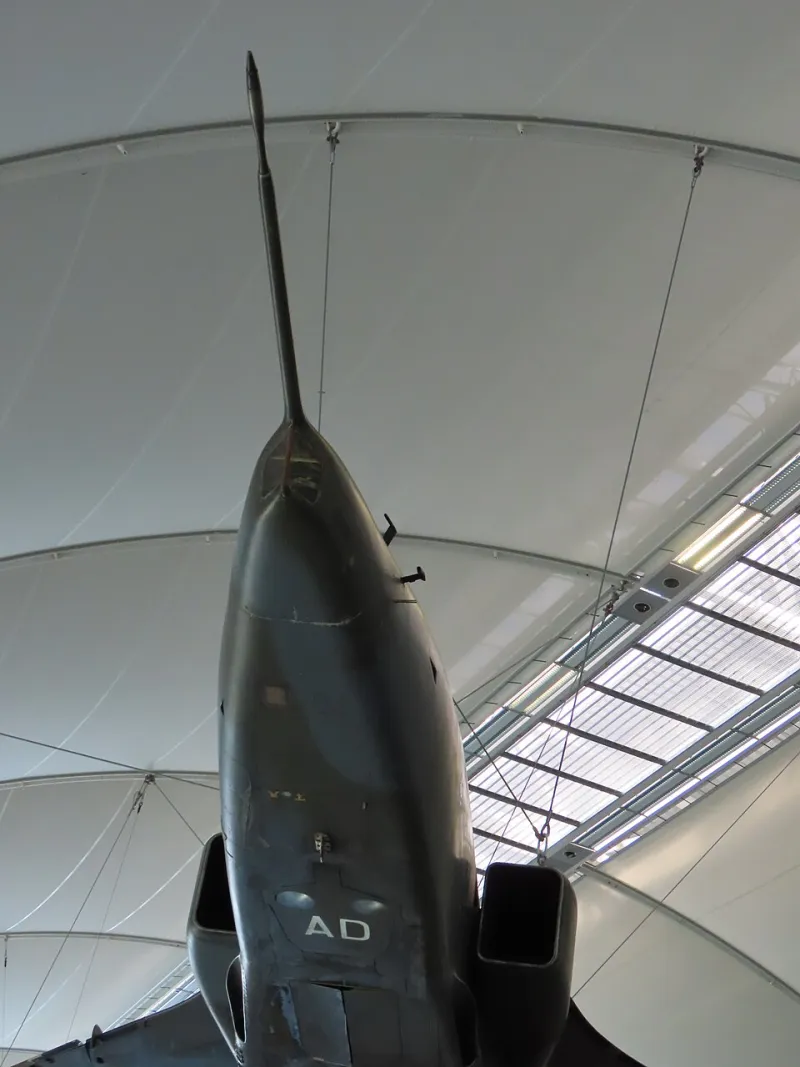
Photo: [[User:Ad Meskens|Ad Meskens You are free to use this picture for any purpose as long as you credit its author, Ad Meskens. Example: © Ad Meskens / Wikimedia Commons If you use this work outside of the Wikimedia projects, a message or a copy is
RAF Jaguar camouflage is one of those subjects that appears simple until it is examined closely. The familiar shorthand is green and grey, followed by grey and gone. In practice, the paint on a Jaguar was never just a finish. It was an operational decision, a squadron statement and, increasingly, a record of when an airframe was repainted, where it served and how it was photographed. For the SEPECAT Jaguar Archive, the useful question is not simply what colour a Jaguar wore, but what the evidence can actually support.
From Wraparound to Low Visibility
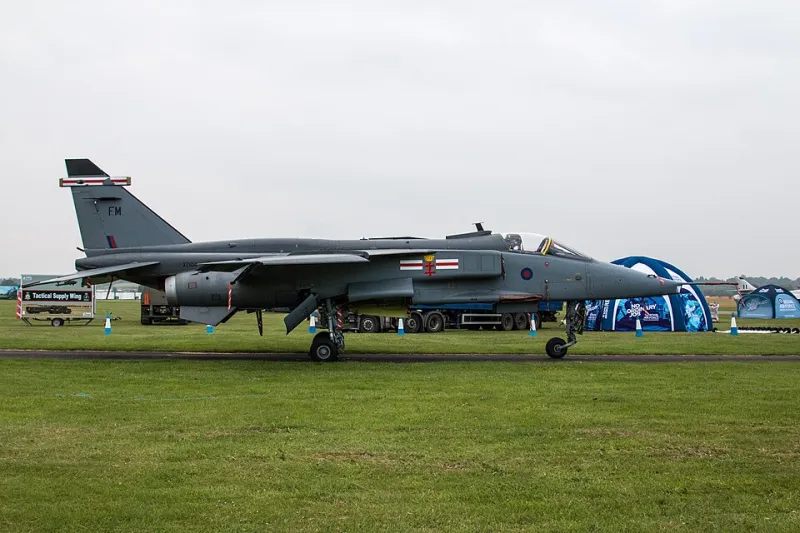
The RAF's Jaguar force entered service with a wraparound camouflage scheme in dark green and dark sea grey, suited to the low-level Central European environment that shaped so much of the aircraft's early RAF career. Photographs from the 1970s and early 1980s generally show a pronounced two-tone upper surface, with the exact balance of green and grey varying with light, film stock and repaint history. That variation matters. A dark green that looks almost black in one transparency can appear distinctly greener in another, and a grey that seems uniform in a distant line-up may reveal patchwork repairs at closer range.
As the force matured, overall grey low-visibility finishes became more prominent. This was not a single, clean transition across every squadron and station. Repainting followed maintenance cycles, unit moves and operational requirements, so mixed appearances could persist. A photograph dated to a particular year may show a scheme applied earlier, or a partial repaint that sits awkwardly between two accepted standards. For modellers, the safest approach is to work from a dated image of the specific airframe rather than from a general rule about what a Jaguar 'should' look like in a given year.
The low-visibility era also changed how squadron identity was expressed. Bright colours and large badges gave way to more restrained markings, though the RAF Jaguar force never lost its unit character entirely. Special tails and anniversary schemes appeared from time to time, often applied at unit level and sometimes only for a short period. These are among the most photographed Jaguars, which creates its own trap: a striking special scheme can dominate search results and make a rare variation seem more typical than it was.
Codes, Badges and the Limits of the Photograph
Markings are where archive photography is most valuable and most easily misread. Serials, unit codes, squadron badges and station markings all help to place an airframe in time, but they do not always agree with one another. A squadron badge may be retained after a unit change, a code may be applied in a slightly different position, and a serial may be partly obscured by stores, open panels or the angle of the shot. Researchers should treat a single photograph as a starting point, not a conclusion.
Colour photography from the period is particularly deceptive. Film type, exposure, fading and scanning all alter apparent hue. A green that looks olive in one collection may look almost blue-grey in another. Black-and-white images remain useful for pattern and marking placement, but they cannot settle colour questions on their own. The most reliable evidence usually comes from a combination of sources: a dated photograph, a known serial, maintenance records where available, and a second image of the same aircraft from a different angle.
Modelling folklore has grown around several persistent claims. One is that every special tail was applied to a factory standard or approved central programme. Another is that all grey Jaguars belong to a single late period. A third is that serial placement was invariable. Archive evidence suggests a more nuanced picture, with local practice, repainting and photographic chance all playing a part. None of this makes the subject unmanageable. It simply means that the modeller or researcher should distinguish between a verified airframe history and a general impression formed from a handful of well-known images.
What Preserved Airframes Can and Cannot Tell Us
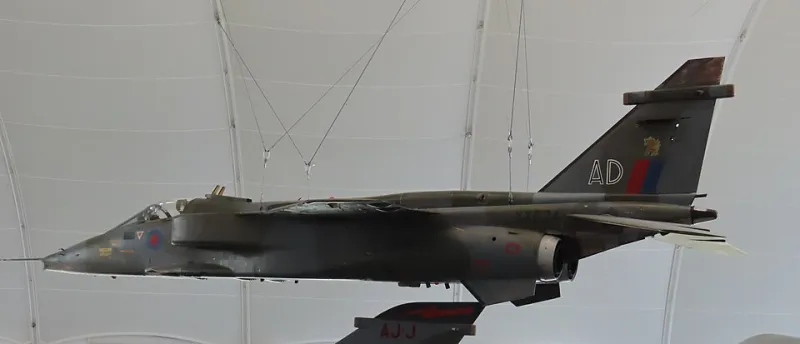
Britain's preserved Jaguars are valuable reference points, but they require careful reading. An aircraft on display may have been repainted in service colours that do not match its final operational appearance, or it may carry markings chosen for presentation rather than historical accuracy. A museum example can still be extremely useful for panel lines, store fit, cockpit layout and overall proportions, but its paint should not be treated automatically as primary evidence for a wartime or squadron scheme.
Visitors in 2026 are well served by the growing number of Jaguars held in UK collections, including examples at Duxford, Cosford, Newark and the Yorkshire Air Museum, among others. The practical approach is to record the serial first, then check the airframe history, then compare the displayed scheme with dated photographs. Where a restoration has deliberately chosen a representative scheme, that choice can be legitimate and informative, but it should be described as a restoration decision rather than an original finish.
A 2026 Reader's Checklist
For anyone using photographs to study RAF Jaguar camouflage, a few habits pay dividends. Identify the variant first: GR1, GR1A, GR3, T2 or T4. Record the serial and any unit codes. Note the date of the photograph, if known, and the source. Look for evidence of repainting, patchwork or local variation. Compare at least two images of the same airframe where possible. Treat special schemes as genuine history but not as the norm. And be cautious with colour judgements made from a single scanned slide.
The Jaguar's RAF career is often summarised as green, grey and gone. That phrase captures the broad arc, but not the texture. The archive evidence shows an aircraft whose finish changed with role, station and time, and whose markings carry stories that are sometimes clear and sometimes provisional. Reading the paint carefully is one way to keep those stories honest.