Allies, Airfields and the Adriatic: RAF Jaguars in the Balkan Campaigns
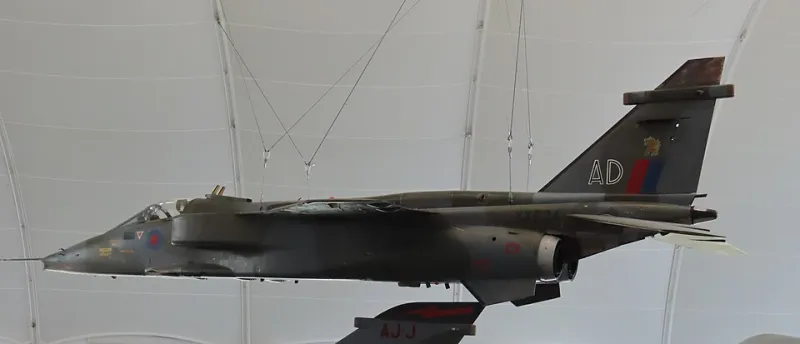
Photo: [[User:Ad Meskens|Ad Meskens You are free to use this picture for any purpose as long as you credit its author, Ad Meskens. Example: © Ad Meskens / Wikimedia Commons If you use this work outside of the Wikimedia projects, a message or a copy is
The RAF Jaguar force's public reputation was fixed, for many enthusiasts, in the desert of 1991. Operation Granby gave the aircraft a vivid and well-documented debut, and the imagery of camouflaged Jaguars far from Coltishall has tended to dominate later accounts. Yet the campaigns that followed in the Balkans did more to test the Jaguar as an expeditionary system. Deployments to forward bases in Italy placed the aircraft, its crews and its ground organisation inside a coalition air campaign that demanded procedural discipline, precise tasking and a maintenance effort quite different from the familiar rhythms of a home-base squadron.
For the Archive, the Balkan years are instructive precisely because they sit between the certainties of the Cold War and the later contraction of the RAF Jaguar force. They show an aircraft and a support chain adapting to coalition warfare in a European theatre, and they expose both the flexibility of the design and the limits of a platform conceived around a very different operational idiom.
From Coltishall to the Adriatic
The move from Norfolk to an Italian forward base was, in administrative terms, a detachment like any other. In operational terms it was a significant reorientation. Jaguars drawn from the Coltishall wing deployed to bases such as Gioia del Colle, supported by a package of groundcrew, spares, test equipment and communications personnel. The aircraft could be moved by conventional transit flights, with air-to-air refuelling where required, but the supporting organisation travelled with its own particular baggage: engine bays, avionics test sets, weapon-loading equipment and the accumulated stock of consumables that kept a demanding airframe serviceable.
The detachment was not a wing in the Granby sense, nor was it intended to be. It was a squadron-sized forward presence designed to plug into a coalition air campaign and to sustain a defined sortie rate over weeks rather than days. Rotation cycles mattered. A squadron could deploy with its own identity and its own engineering culture, but the forward base demanded a common standard of documentation, servicing and mission preparation. The result was a small expeditionary organism in which the squadron's familiar routines were compressed, formalised and exposed to scrutiny by allies and by the campaign's operational tempo.
Coalition Tasking and the Medium-Level Compromise
The Balkans forced a change in tactical emphasis. Jaguar crews had trained for low-level attack in the Central Region, using terrain, speed and surprise to survive in a dense threat environment. In the Adriatic campaigns, the threat from surface-to-air missile systems, the coalition's rules of engagement and the political sensitivity of collateral damage all pushed operations toward medium altitudes. The aircraft's low-level idiom did not disappear, but it ceased to be the default setting for every mission.
Coalition tasking brought its own demands. Missions were generated through the combined air operations centre and expressed in the air tasking order, with packages, timing and tanker support allocated across nations. Jaguar crews had to work within NATO procedures, secure communications and identification regimes that were not always second nature to a force accustomed to national tasking. The aircraft's navigation and attack system, laser ranging and marked-target seeker, and its ability to carry reconnaissance pods or precision-guided weapons, made it a useful coalition contributor. But usefulness was not the same as independence. The Jaguar depended on allied enablers for suppression of enemy air defences, electronic warfare support and, frequently, tanker availability.
Reconnaissance was one of the more revealing roles. The Jaguar's recce pod gave the coalition a responsive tactical imaging capability, and the aircraft's speed and range made it suitable for the task. Precision attack, typically using laser-guided bombs with designation from a pod or a cooperating aircraft, demonstrated that the Jaguar could operate in the medium-level precision role. Yet the same missions exposed the crew workload and sensor limitations of a design that had been optimised for a different kind of war.
The Technical Bill
The expeditionary footing also exposed the maintenance argument. The Adour engine was a robust and well-understood powerplant, but it demanded disciplined servicing and a supply chain that could reach from Norfolk to southern Italy. Avionics, hydraulics and the recce or designation pods all generated their own spares and test requirements. The forward base had to provide shelters, power, fuel, weapons storage and a secure working environment, while the detachment's own personnel had to maintain the aircraft to a standard acceptable to both the RAF and the coalition.
Turnarounds became a measure of the detachment's health. A Jaguar returning from a coalition mission might require fuel, weapons, oxygen, nitrogen and a post-flight inspection before being declared ready for the next tasking. The engineering effort was not merely a question of speed; it was a question of evidence. Every servicing action had to be recorded, every defect assessed and every mission-critical system verified. In a coalition environment, the detachment's credibility rested as much on its paperwork and its engineering discipline as on the aircraft's performance over the target.
Limits and Lessons
The Balkan deployments did not turn the Jaguar into a different aircraft. They revealed what it could do when pushed into a coalition campaign, and they revealed where it was constrained. Payload and range remained finite. Self-defence was limited. The cockpit workload in complex medium-level packages could be high. The aircraft's sensors and mission systems, capable in their day, were not immune to the pace of coalition requirements.
Yet the deployments also showed the value of a simple, rugged and adaptable strike platform. The Jaguar could reconnaissance, designate, bomb and support ground forces within the same campaign, often from the same forward base and with the same support organisation. That flexibility was not unlimited, but it was real. The Balkan years therefore deserve a more careful place in the Jaguar story than the usual Granby-centred narrative allows. They were the force's European expeditionary test, and the lessons drawn from them informed the final chapter of RAF Jaguar operations.